

Concrete Vibrator Guide: When and How to Use One for Better Concrete Pours
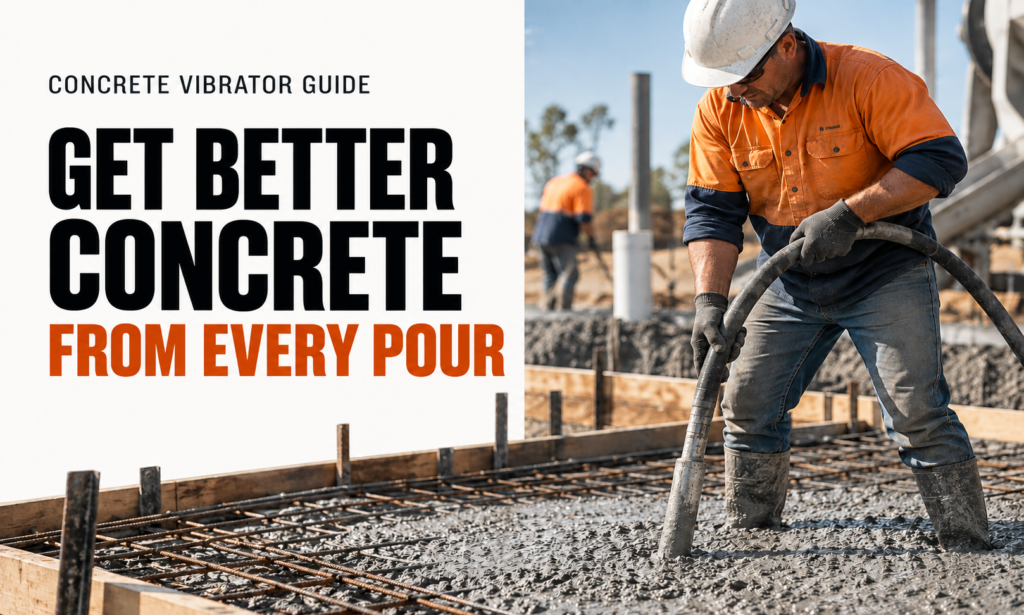
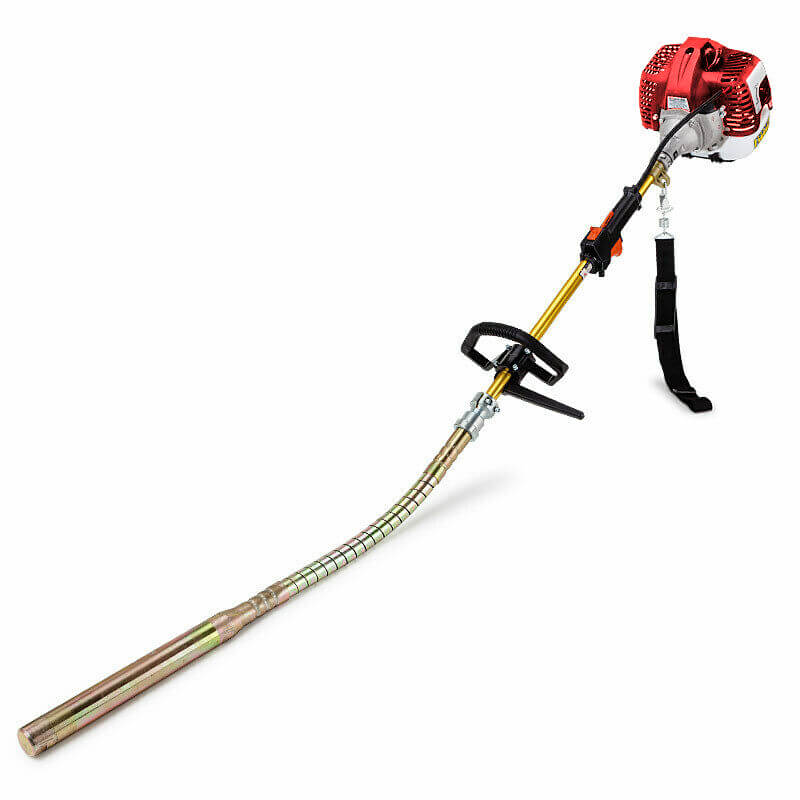
A concrete vibrator is a powered tool that compacts freshly placed concrete by shaking it at high frequency, releasing entrapped air so the mix settles tightly around reinforcement and formwork.
Use one on footings, columns, walls, beams and slabs thicker than about 150 mm. Insert the head vertically, hold it still until the air bubbles stop rising, then withdraw it slowly. Concrete containing 10 per cent entrapped air can lose as much as half its strength.
KEY TAKEAWAYS
- Immersion (poker) vibrators suit footings, columns, walls and beams. Vibrating screeds suit slabs under about 200 mm.
- A 30 to 60 mm head covers most residential slabs, walls and beams. Use 50 to 90 mm for heavy footings and 20 to 40 mm for congested reinforcement.
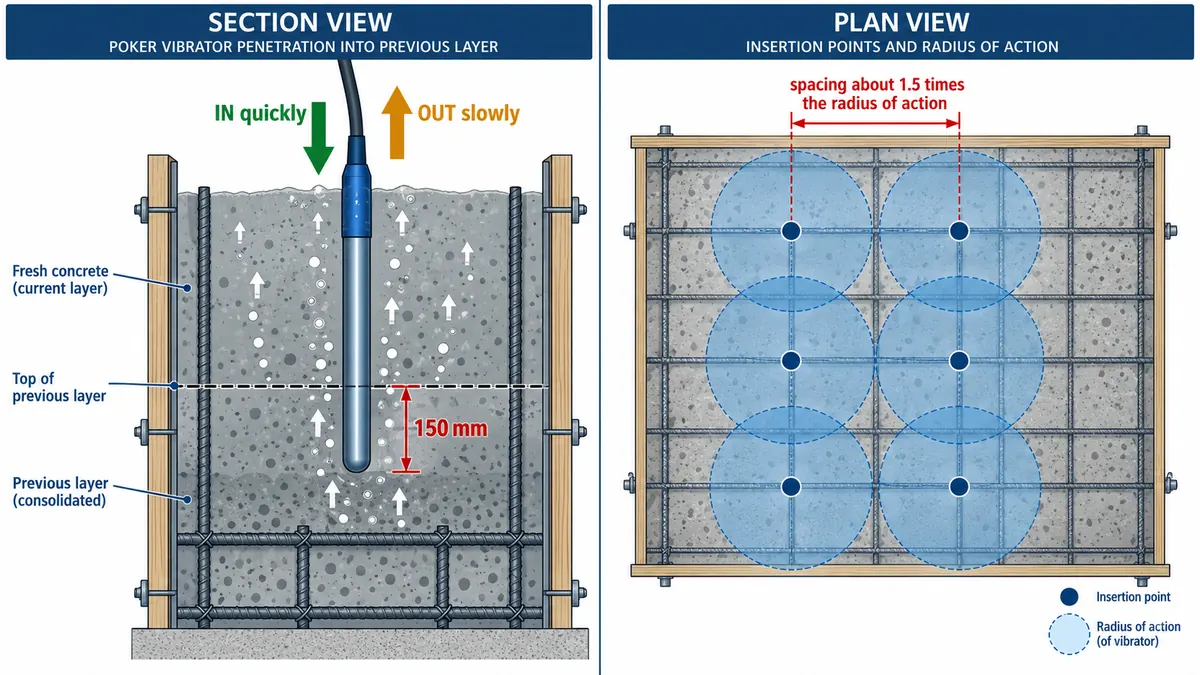
- Space insertions at about 1.5 times the head's radius of action and penetrate about 150 mm into the layer below.
- Hold the head still for about 15 to 20 seconds per insertion, until air bubbles stop rising to the surface.
- Never use the vibrator to move concrete sideways in the forms. It causes segregation and a weak, stony finish.
- Concrete with 10 per cent entrapped air can lose up to 50 per cent of its strength compared with fully compacted concrete.
Which Concrete Vibrator Should You Buy?
Buy an immersion (poker) vibrator for footings, columns, walls and thick slabs, and a vibrating screed for flatwork under about 200 mm.
Choose an immersion (poker) vibrator if your work involves footings, columns, walls, beams or slabs over about 150 mm. A 30 to 60 mm head covers most residential and light commercial work. Choose a vibrating screed if you mainly pour driveways, paths and slabs under about 200 mm. Most concreters end up owning both, because a screed cannot compact the full depth of a footing and a poker cannot level a slab.
| Your main work | Buy this | Head size |
|---|---|---|
| House slabs, footings, beams | Immersion (poker) vibrator | 30 to 60 mm |
| Heavy strip footings, mass pours | Immersion (poker) vibrator | 50 to 90 mm |
| Columns, blade walls, congested reo | Immersion (poker) vibrator | 20 to 40 mm |
| Driveways, paths, flatwork | Vibrating screed | Not applicable |
| Precast panels, thin walls | External form vibrator | Not applicable |
| Patch repairs, post footings | Cordless or drill attachment | 20 to 40 mm |
Buy a spare flexible drive shaft at the same time. The shaft is the first part to fail, and a failed shaft stops a pour rather than delaying it. Browse the concrete vibrator range at GPT Tools to compare drive units and spare parts.
What a Concrete Vibrator Does
A concrete vibrator releases entrapped air from placed concrete so the mix reaches its designed density and bonds properly to reinforcement.
Fresh concrete leaves the truck full of air pockets. Vibration briefly makes the mix behave like a liquid. Heavier particles settle, air rises to the surface, and the concrete flows into the corners of the form and around the steel.
The strength cost of skipping compaction is high. CCAA states that concrete containing 10 per cent entrapped air can lose as much as 50 per cent of its strength compared with fully compacted concrete. The American Concrete Institute puts the relationship at roughly a 5 per cent strength reduction for every 1 per cent increase in air void volume.
Compaction also improves:
- Bond between the concrete and the steel reinforcement
- Resistance to water ingress and chemical attack
- Off-form surface finish, with fewer blowholes
- Long term durability and resistance to cracking
Vibration is not spreading. The tool compacts concrete that has already been placed. Moving concrete around the form with the head separates the stone from the mortar.
When You Need a Concrete Vibrator
Use a concrete vibrator whenever the pour contains reinforcement, has depth, or must achieve a specified strength.
Pours That Need One
- Strip footings and pad footings
- Columns, piers and blade walls
- Retaining walls and core-filled blockwork
- Suspended slabs and beams
- Slabs thicker than about 150 mm
- Any pour with congested reinforcement
- Off-form concrete where the finished face will be visible
- Stiff, low slump mixes
Pours That May Not Need One
- Self-compacting concrete, which flows and releases air without vibration
- Thin, highly workable slabs where a vibrating screed does the work
- Small domestic jobs such as fence post footings and clothesline bases
- Shallow decorative pours that are rodded by hand
Check the engineer’s specification before deciding. Compaction of structural concrete in Australia is governed by AS 3600 Concrete structures, and the supply of the concrete itself sits under AS 1379 Specification and supply of concrete. Where the specification calls for mechanical compaction, hand rodding is not a substitute.
Concrete Vibrator Types at a Glance
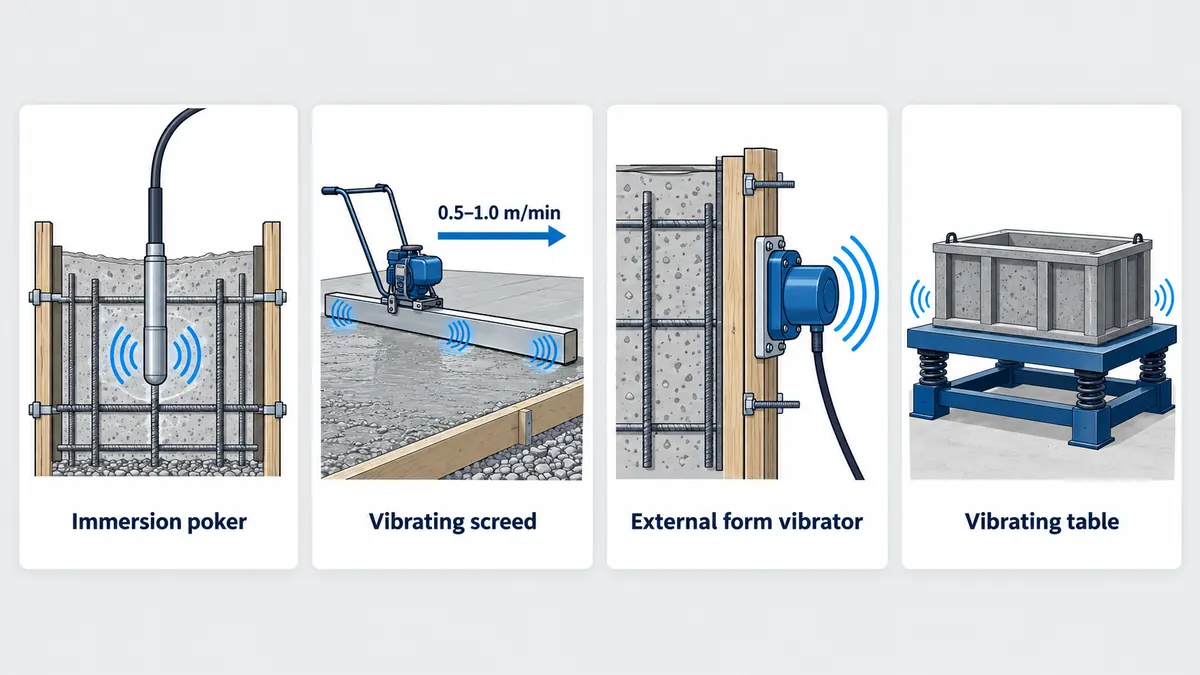
The four types are immersion (poker) vibrators, vibrating screeds, external form vibrators and vibrating tables.
| IMMERSION (POKER) VIBRATOR | VIBRATING SCREED |
|---|---|
| ✓ Vibrating head inserted into the pour ✓ Best for footings, columns, walls, beams ✓ Compacts the full depth of the section ✓ Head sizes from 20 mm to 150 mm ✓ Needs access from above the pour ✓ The type most concreters buy first | ✓ Vibrating beam drawn across the surface ✓ Best for slabs and pavements ✓ Compacts and levels in one pass ✓ Suits slabs under about 200 mm thick ✓ Only works the top of the pour ✓ Ideal for driveways and flatwork |
| Feature | Immersion (poker) | Vibrating screed | External form vibrator |
|---|---|---|---|
| Where it acts | Inside the concrete | On the top surface | On the outside of the form |
| Best for | Footings, columns, walls, beams | Slabs and pavements | Precast panels, thin walls |
| Depth compacted | Full depth of the layer | Top portion only | Full depth of thin sections |
| Slab thickness | Any, in layers | Under about 200 mm | Thin sections |
| Congested reinforcement | Yes, with a small head | No | Yes, no internal access needed |
| Main limitation | Needs access from above | Surface compaction only | Forms must take the load |
| Site or factory | Site | Site | Mostly factory and precast |
Which Vibrator Suits Your Job?
An immersion vibrator suits footings, columns, walls and thick slabs. A vibrating screed suits flatwork.
House Slabs and Footings
Best choice: Immersion vibrator with a 30 to 60 mm head. That size gives a radius of action of roughly 130 to 250 mm and fits between typical reinforcement spacing. Work the thickened edges, perimeter beams and reinforced sections, then bring the surface to level with a screed. Heavier strip footings and mass pours call for a 50 to 90 mm head.
Columns, Walls and Off-Form Work
Best choice: Immersion vibrator, placed in layers. Off-form faces show every compaction fault. Place the concrete in layers the head can reach, penetrate about 150 mm into the layer below, and keep the head clear of the form face. Congested blade walls and columns may need a 20 to 40 mm head to fit between bars.
Driveways and Flatwork
Best choice: Vibrating screed. A vibrating screed compacts and levels slabs less than about 200 mm thick in one pass, at a forward speed of 0.5 to 1.0 metres per minute. Use an immersion vibrator around the thickened edges and reinforced sections, then screed the surface.
Precast and Repair Work
Best choice: External form vibrator or a small poker. External vibrators clamp to the outside of the formwork and suit thin precast panels with no room for a head inside. For patch repairs and small sections, a cordless or drill attachment vibrator with a 20 to 40 mm head is usually enough.
Petrol, Electric and Cordless Drive Units
Choose the drive type by the power available on site: petrol for no mains power, electric for 240 V or generator supply, cordless for short pours and tight access.
| Drive type | Suits | Limitations |
|---|---|---|
| Petrol drive unit | Sites with no mains power; long footing and wall pours | Heavier; needs fuel, servicing and clear ventilation |
| Electric drive unit | Sites with 240 V power or a generator; quieter work | Lead and power supply limit where you can work |
| Cordless or drill attachment | Short pours, repairs, post footings, tight access | Battery runtime and small head size limit larger jobs |
A petrol unit paired with a spare flexible drive shaft covers most general construction work, because the shaft is the part that wears out first.
How to Choose the Right Head Size
Match the head diameter to the section thickness and the reinforcement spacing. A larger head reaches further but will not fit between closely spaced bars.
| Head diameter | Frequency | Radius of action | Insertion spacing | Typical application |
|---|---|---|---|---|
| 20 to 40 mm | 150 to 250 Hz | 80 to 150 mm | 120 to 225 mm | Thin sections, congested reinforcement, repairs |
| 30 to 60 mm | 140 to 210 Hz | 130 to 250 mm | 195 to 375 mm | Walls, columns, beams, house slabs |
| 50 to 90 mm | 130 to 200 Hz | 180 to 360 mm | 270 to 540 mm | Heavy footings, mass pours, general construction |
| 80 to 150 mm | 120 to 180 Hz | 300 to 500 mm | 450 to 750 mm | Large civil pours and heavy foundations |
Head diameter, frequency and radius of action from CCAA, Guide to Concrete Construction, Part V Section 13 : Compaction, 2020 edition. Insertion spacing calculated at 1.5 times the radius of action.
How to Use a Concrete Vibrator Step by Step
Insert the head vertically and quickly, hold it still until the air bubbles stop rising, then withdraw it slowly. Each insertion takes about 15 to 20 seconds.
- Check the equipment before the truck arrives. Inspect the shaft for kinks, check the head for damage and confirm the engine or motor starts.
- Place the concrete in layers. Keep each layer to a depth the head can reach, generally no more than the working length of the head.
- Plan an insertion pattern. Space insertions at about 1.5 times the radius of action, in a grid or staggered pattern, so the vibrated zones overlap.
- Insert the head vertically and quickly. Let it drop under its own weight. Do not push it in at an angle unless access forces you to.
- Penetrate about 150 mm into the previous layer. This knits the layers together and prevents a cold joint.
- Hold the head still. Wait until air bubbles stop rising. CCAA recommends about 15 to 20 seconds. Concrete Basics recommends 5 to 15 seconds at 80 mm slump with a 25 to 75 mm poker. Watch the concrete, not the clock.
- Withdraw the head slowly. About 75 mm per second. Pulling out too fast leaves a hole that does not close behind the head.
- Move to the next insertion point. Repeat across the pour, keeping to your pattern.
- Keep clear of formwork, reinforcement and embedded items. Contact marks off-form faces, loosens the bond around steel and damages the head.
- Finish the surface once compaction is complete. A vibrating screed can then compact and level thin slab sections.
Common Mistakes That Ruin a Pour
The most damaging mistakes are using the vibrator to move concrete sideways, under-vibrating, and withdrawing the head too quickly.
| Mistake | What goes wrong | What to do instead |
|---|---|---|
| Moving concrete sideways with the head | Segregation. The mortar runs ahead and the stone stays behind | Move concrete with a shovel or rake, then compact |
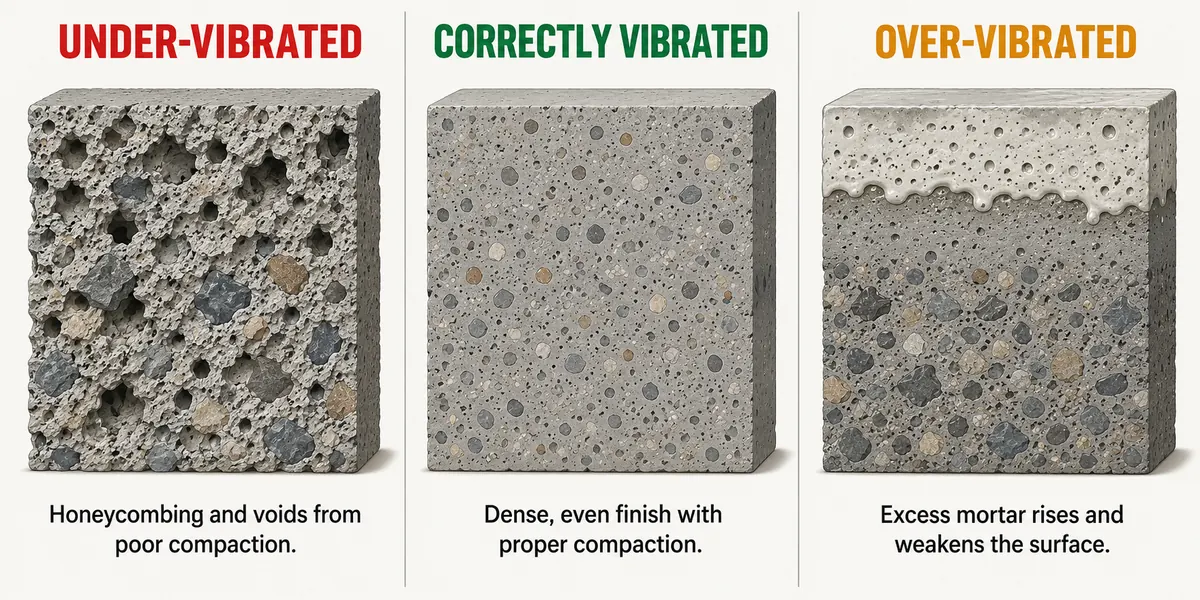
| Under-vibrating | Honeycombing, blowholes and exposed reinforcement. Worse than over-vibrating | Vibrate until the air bubbles stop rising |
| Over-vibrating | Excess mortar at the surface, a frothy appearance, and loss of entrained air | Stop once the bubbles stop |
| Withdrawing too quickly | A void running up through the section where concrete could not close | Withdraw at about 75 mm per second |
| Dragging the head along the form | Marked off-form faces and a dented or cracked head housing | Keep the head clear of the formwork |
| Skipping the layer overlap | A visible line and a weak plane between lifts | Penetrate about 150 mm into the layer below |
| Coiling the shaft tightly | The shaft overheats and fails mid-pour | Store and run the shaft in a gentle curve |
Hand-Arm Vibration Exposure and Safety
Concrete vibrators expose the operator to hand-arm vibration, which can cause hand-arm vibration syndrome (HAVS). Australia sets no workplace exposure standard for vibration.
Safe Work Australia’s guidance notes that the values in EU Directive 2002/44/EC are widely used and accepted. Symptoms of HAVS include tingling and numbness in the fingers after using vibrating tools, and the damage can be permanent.
| Exposure value | Daily average A(8) | What it means |
|---|---|---|
| Exposure action value | 2.5 m/s² | Take steps to reduce exposure above this level |
| Exposure limit value | 5.0 m/s² | Exposure should not exceed this level |
Check the declared vibration value for the specific machine before planning a long pour. Worn shafts and damaged heads often vibrate more than the declared figure, so equipment condition affects operator exposure as well as compaction quality.
Practical controls on a concrete pour:
- Rotate operators so no one person runs the poker all day
- Choose equipment with lower declared vibration values
- Keep the shaft and head in good order
- Take regular breaks and keep hands warm
- Report tingling or numbness early
- Wear gloves, eye protection and waterproof boots, because wet concrete is caustic
- Keep petrol units out of enclosed spaces, and leads clear of standing water
This information is general guidance. Follow your site’s safe work method statement and the manufacturer’s instructions for the specific machine.
Maintenance and Spare Parts
The flexible shaft and the vibrating head wear faster than the drive unit. Treat them as consumables and carry a spare.
- Hose the head and shaft down before the concrete sets on them
- Never let concrete cure inside the head housing
- Check the shaft casing for splits, kinks and heat damage after each pour
- Grease the shaft at the interval given in the manual
- Store the shaft in a gentle coil, not a tight loop
- Keep a spare shaft and head on hand for larger jobs
Keeping spare parts and accessories on hand matters more on concrete work than on most trades, because a pour cannot be paused while you find a replacement.
Hire or Buy a Concrete Vibrator?
Hire for a one-off pour. Buy once you pour concrete several times a year, because hire fees across a handful of jobs often approach the purchase price.
| Consider hiring when | Consider buying when |
|---|---|
| You have a single pour planned | You pour several times a year |
| The job needs a head size you will not use again | You want the same machine and settings every time |
| You have nowhere to service or store a unit | Downtime waiting on a hire branch would cost you |
| The pour is large and needs several units at once | You need a unit available at short notice |
Owning a machine also means you control its condition, which affects both compaction quality and vibration exposure.
Buy Your Concrete Vibrator at GPT Tools
GPT Tools has supplied Australian tradespeople and DIY customers with tools and equipment since 2002, from our Campbellfield store in Melbourne and online across Australia. Contact our team about the right head size and drive unit for the pours you have coming up, or browse the current concrete vibrators and spare parts. Australia-wide delivery is available on eligible products, and warranty conditions vary by product.
Frequently Asked Questions
Hand rodding with a steel bar can compact small, shallow, workable pours such as fence post footings. It is not a reliable substitute for mechanical vibration on structural concrete, congested reinforcement or off-form work. Where a specification or AS 3600 requires mechanical compaction, use a vibrator. Tapping the formwork with a hammer is not effective compaction.
Hold the head still until air bubbles stop rising to the surface. CCAA recommends about 15 to 20 seconds per insertion for immersion vibrators. The Concrete Basics guide nominates 5 to 15 seconds for average workability concrete at around 80 mm slump using a 25 to 75 mm poker. Watch the surface rather than counting, because slump, head size and section depth all change the time needed.
A head in the 30 to 60 mm range suits most residential slabs, beams and walls. That size gives a radius of action of roughly 130 to 250 mm and fits between typical reinforcement spacing. Heavier footings and mass pours call for a 50 to 90 mm head. Congested sections and repairs may need a 20 to 40 mm head.
Space insertions at about 1.5 times the head’s radius of action so the vibrated zones overlap. For a 30 to 60 mm head with a radius of action of 130 to 250 mm, that is roughly 195 to 375 mm between insertion points. Use a grid or staggered pattern so no part of the pour is missed.
Over-vibration brings an excessive thickness of mortar to the surface and can give the concrete a frothy appearance. The coarse aggregate sinks while the paste rises, which weakens the top of the section. On air-entrained concrete, it also drives out the entrained air the mix needs.
Yes, though the method differs. A vibrating screed compacts and levels slabs less than about 200 mm thick in one pass and is usually the better tool for flatwork. Use an immersion vibrator around the thickened edges, perimeter beams and reinforced sections, then screed the surface.
Compact first, then screed. Place and compact each layer with the immersion vibrator, then bring the surface to level with a screed. A vibrating screed does both jobs at once on thin slabs, but it will not compact the full depth of a thicker pour.
There is no fixed interval. The flexible shaft is a wearing part, and its life depends on how often it is used, how tightly it is coiled and whether concrete is washed off before it sets. Inspect the casing for splits, kinks and heat damage after each pour, and replace it once the casing is damaged or the shaft runs hot.
Related Concreting Equipment at GPT Tools
-
62CC CONCRETE VIBRATOR Commercial Portable Tool Unit
Out of StockOriginal price was: $599.00.$350.00Current price is: $350.00. Inc. GST -
FLEXIBLE DRIVE SHAFT FOR CONCRETE VIBRATER ( Free Shipping )
Out of StockOriginal price was: $78.00.$49.00Current price is: $49.00. Inc. GST