

How to Choose the Right Paint Sprayer for DIY and Professional Use
A paint sprayer atomises paint into a fine mist and lays it down as an even film, covering large areas far faster than a brush or roller.
An airless sprayer forces paint through a small tip at high pressure with no compressed air, which suits walls, ceilings, fences and roofs. An HVLP sprayer atomises with a high volume of air at up to 10 psi, which suits doors, trim and cabinetry. An air spray gun needs a compressor sized to the gun. Match the tip to the coating, not to the sprayer.
KEY TAKEAWAYS
- Airless sprayers handle unthinned paint at high pressure and cover large flat areas fastest. They suit walls, ceilings, fences and roofs.
- HVLP sprayers run at up to 10 psi at the air cap and put 70 to 90 per cent of the paint on the job. They suit doors, trim, cabinetry and furniture.
- An air spray gun needs a compressor sized to the gun's air consumption, so check the air requirement before buying either part.
- Airless tip numbers decode simply: the first digit multiplied by 2 is the fan width in inches at 300 mm, and the last two digits are the orifice in thousandths of an inch.
- Match the orifice to the coating: 0.006 to 0.013 in for stains, 0.013 to 0.015 in for lacquers and enamels, 0.015 to 0.019 in for latex and acrylic.
- Spraying 2-pack isocyanate paint requires a full-face airline respirator to AS/NZS 1716, a fully enclosed booth and health monitoring. It is not a DIY job.
Which Paint Sprayer Should You Buy?
Buy an airless sprayer for walls, fences and large exterior work. Buy an HVLP sprayer for trim, doors and cabinetry. Buy an air spray gun and a matched compressor for automotive and fine finishing.
Most people painting a house choose an airless sprayer, because it handles unthinned paint and covers large flat areas faster than anything else. Most people finishing joinery choose HVLP, because it wastes far less paint and leaves a finer finish on detailed work. Tradespeople who do both usually own an airless unit and an HVLP or air gun, rather than compromising with one machine.
| Your main work | Buy this | Why |
|---|---|---|
| Interior walls and ceilings | Airless sprayer | Covers large flat areas fastest and sprays unthinned paint |
| Fences, decks, sheds and roofs | Airless sprayer | Handles exterior paint and stain without thinning, and reaches rough surfaces |
| Doors, trim, skirting and cabinetry | HVLP sprayer | Finest finish on detail work, with the least overspray |
| Furniture and joinery | HVLP sprayer | Controllable at low pressure, so thin coats build evenly |
| Automotive and panel work | Air spray gun and compressor | Fine control over pattern and flow, and suits 2-pack in a booth |
| Touch-ups and small jobs | Handheld or cordless unit | Portable with almost no setup or cleanup |
Airless or HVLP: Which Should You Choose?
Choose airless for speed and coverage on large surfaces. Choose HVLP for control and finish quality on detail work. Airless moves more paint; HVLP wastes less of it.
| AIRLESS SPRAYER | HVLP SPRAYER |
|---|---|
| ✓ Atomises by pressure alone, no air ✓ Sprays most paint unthinned ✓ Highest output for large areas ✓ Walls, ceilings, fences, roofs ✓ More overspray, so more masking ✓ Tip size sets fan width and flow | ✓ Atomises with a high volume of air ✓ Up to 10 psi at the air cap ✓ 70 to 90 per cent transfer efficiency ✓ Doors, trim, cabinetry, furniture ✓ Least overspray and waste ✓ Slower on large flat surfaces |
| Airless | HVLP | |
|---|---|---|
| Atomises using | High pressure, no air | A high volume of air at low pressure |
| Working pressure | Up to 3,000 psi at the pump | Up to 10 psi at the air cap |
| Transfer efficiency | Lower – more paint becomes overspray | 70 to 90 per cent |
| Speed on a wall | Fastest of any method | Slow, and not intended for it |
| Finish on trim | Good, but harder to control | Finest available from a hand-held gun |
| Paint thinning | Usually none needed | Often required |
| Masking required | Extensive | Minimal |
| Buy it if | You paint rooms, fences, roofs or exteriors | You finish doors, trim, cabinetry or furniture |
Most tradespeople who do both eventually own one of each, because neither machine does the other’s job well. Where budget allows only one, let the larger share of your work decide.
Four Ways to Spray Paint
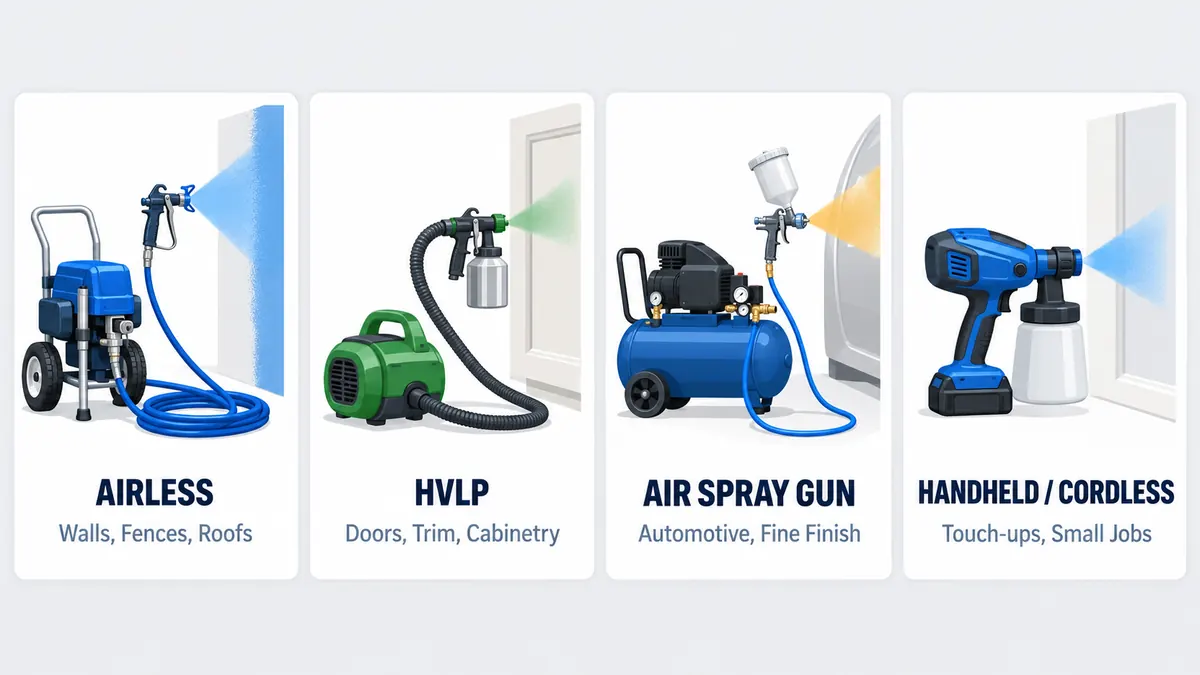
The four options are airless sprayers, HVLP sprayers, conventional air spray guns and handheld cordless units. They differ in how they atomise the paint.
| Feature | Airless | HVLP | Air spray gun | Handheld/cordless |
|---|---|---|---|---|
| Atomises using | High pressure | High air volume | Compressed air | Small pump or turbine |
| Needs a compressor | No | No, uses a turbine | Yes | No |
| Best for | Walls, fences, roofs | Trim, cabinetry | Automotive, fine finish | Touch-ups, small jobs |
| Overspray | High | Lowest | Moderate to high | Moderate |
| Paint thinning | Usually none needed | Often required | Often required | Usually required |
| Setup and cleanup | Longest | Moderate | Moderate | Shortest |
| Output | Highest | Moderate | Moderate | Lowest |
Which Sprayer Suits Your Job?
Airless suits large flat areas. HVLP suits detail work. An air spray gun suits automotive and fine finishing.
Interior Walls and Ceilings
Best choice: Airless sprayer. An airless paint sprayer sprays standard interior acrylic without thinning and covers a room far faster than a roller. A tip in the 0.015 to 0.019 in range suits latex and acrylic paint. Budget the time you save on rolling against the time you spend masking, because airless overspray travels.
Fences, Decks, Sheds and Roofs
Best choice: Airless sprayer. Rough and profiled surfaces take far longer to brush than to spray. Airless handles exterior paint and stain at full strength, and a wider fan covers palings and sheeting quickly. Spray on a still day, because wind carries overspray onto cars and neighbouring property.
Doors, Trim, Skirting and Cabinetry
Best choice: HVLP sprayer. HVLP atomises with air volume rather than pressure, so the paint arrives with less force and less bounce-back. Titan reports transfer rates between 70 and 90 per cent, which, on detailed work, means less wasted paint and far less masking than airless.
Titan also notes that HVLP sprayers should not be treated as the alternative for spraying large flat surfaces on a regular basis. They are a finishing tool.
Automotive and Fine Finishing
Best choice: Air spray gun with a matched compressor. A conventional gun gives fine control over pattern, fluid flow and air pressure, which is why panel shops use them. An air spray gun is only half the purchase: the compressor has to supply the gun’s air consumption continuously, not in short bursts.
How Airless Spray Tips Are Numbered
An airless tip number is two pieces of information. The first digit multiplied by 2 is the fan width in inches at 300 mm, and the last two digits are the orifice size in thousandths of an inch.
A 515 tip therefore sprays a 10-inch (250 mm) fan through a 0.015 in opening. A 315 tip sprays the same amount of paint through a 6-inch fan, so it lays the coat on thicker.
Match the Orifice to the Coating
The orifice size is set by what you are spraying, not by the sprayer you own.
| Coating | Orifice size | Typical use |
|---|---|---|
| Stains and varnish | 0.006 to 0.013 in | Decking oil, timber stain, clear finishes |
| Lacquers and enamels | 0.013 to 0.015 in | Doors, trim, joinery, enamel topcoats |
| Latex and acrylic paint | 0.015 to 0.019 in | Interior and exterior wall paint |
| Elastomeric and block filler | 0.025 to 0.035 in and above | Membrane coatings, texture, block fill |
Orifice ranges from Graco. A tip that is too large for thin paint causes runs; a tip that is too small for thick paint starves the gun and leaves tails in the pattern.
Replace Tips Before They Cost You Paint
Tips wear. Graco notes that as a tip wears, the orifice grows and the fan narrows, which forces more passes, increases overspray and wastes a substantial amount of paint. A fan that has dropped noticeably in width is telling you the tip is finished, well before the sprayer shows any other symptom.
What Size Compressor Do You Need for an Air Spray Gun?
Size the compressor to the gun’s continuous air consumption, not to its peak. A compressor that cannot keep up will cause the pattern to fade and spit mid-pass.
Conventional and HVLP conversion guns are rated in air consumption at a working pressure. Check three things on the gun before choosing a compressor:
- The gun’s air consumption at its working pressure
- The compressor’s free air delivery at that same pressure, not its maximum rating
- Tank size, which buffers demand but does not replace delivery capacity
A compressor rated on its maximum pressure alone tells you very little. Compare free air delivery at the pressure you will actually spray at, and allow headroom so the motor is not running continuously. Undersizing is the most common reason a new spray gun sprays badly.
Workshops on mains power usually run an electric air compressor, while site and rural work without power needs a petrol air compressor. Either way, budget for the hoses, regulators and water traps as well, because moisture in the line will spoil a finish no matter how good the gun is.
How to Spray Paint Properly: Step by Step
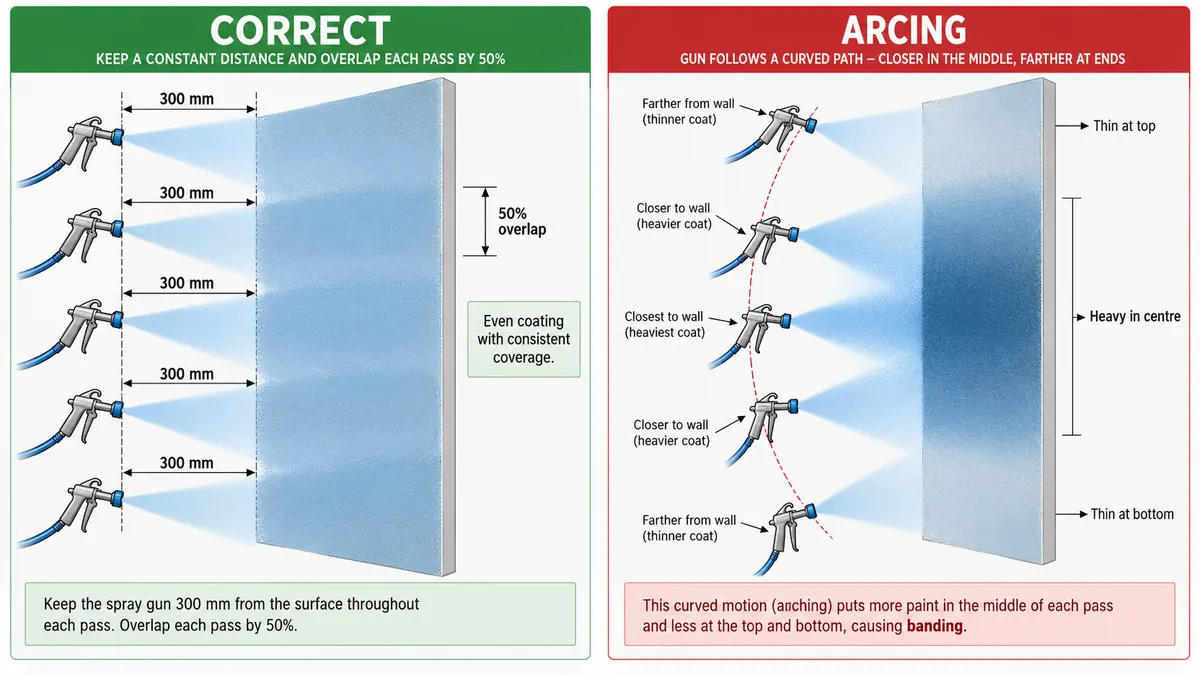
Hold the gun about 300 mm from the surface, move parallel to it at a steady speed, and overlap each pass by about half.
- Prepare and mask first. Spraying is fast, so the preparation dominates the job. Mask further than you think you need to, especially with airless.
- Strain the paint. A single lump will block a tip mid-pass and cost more time than straining ever does.
- Set the pressure or air to the lowest that atomises cleanly. Higher pressure than necessary adds overspray without improving the finish.
- Test the pattern on cardboard. Check for an even fan with no heavy edges or tails before you touch the work.
- Hold the gun about 300 mm from the surface. Keep that distance constant through the whole pass.
- Move parallel to the surface, not in an arc. Move your whole arm. Swinging from the wrist changes the distance and leaves banding.
- Start moving before you pull the trigger. Release the trigger before you stop at the end of the pass, so the ends are not heavy.
- Overlap each pass by about 50 per cent. Aim the edge of the fan at the centre of the previous pass.
- Apply two thin coats rather than one heavy one. Let the first flash off for the time the paint data sheet specifies.
- Clean the sprayer immediately. Dried paint in the pump, hose or tip is the most common cause of failure.
Common Paint Spraying Mistakes
Most spray faults come from distance, speed and preparation rather than from the sprayer itself.
| Mistake | What goes wrong | What to do instead |
|---|---|---|
| Arcing the gun | Heavy in the centre of each pass, thin at the ends, visible banding | Move the whole arm parallel to the surface |
| Holding the gun too far away | Dry spray, a rough gritty finish, heavy overspray | Keep about 300 mm from the surface |
| Holding the gun too close | Runs and sags from too much paint in one place | Keep the distance constant and speed up slightly |
| Too little overlap | Visible stripes where passes did not meet | Aim the fan edge at the centre of the previous pass |
| One heavy coat instead of two thin ones | Runs, sags and a long drying time | Two thin coats with a proper flash-off between |
| Wrong tip for the coating | Runs with thin paint, tails and starving with thick paint | Match the orifice to the coating |
| Not straining the paint | A blocked tip partway through a wall | Strain every batch before it goes in |
| Leaving cleanup until later | Dried paint in the pump, hose and tip | Clean immediately after the last pass |
Respiratory Protection and Spray Painting Safety
Spraying puts paint into the air as a respirable mist, so the protection needed rises sharply with the coating. Two-pack isocyanate paint requires a full-face airline respirator, an enclosed booth and health monitoring.
Respirators used at work should comply with AS/NZS 1716, and selection, use and maintenance sit under AS/NZS 1715. WorkSafe Queensland states that fit testing should happen before a respirator is first used and at least annually, and that workers should be clean-shaven where the facepiece seals against the skin.
Two-Pack Isocyanate Paint Is Not a DIY Job
WorkSafe Victoria’s guidance on spraying isocyanate paints is explicit. Use a full-face airline respirator meeting AS/NZS 1716, spray in a fully enclosed booth vented safely outside, and provide health surveillance including lung function testing under the supervision of a doctor. A separate WorkSafe Victoria safety alert sets out the health consequences of exposure.
| Control | Requirement |
|---|---|
| Respiratory protection | Full-face airline respirator meeting AS/NZS 1716, removed only outside the booth |
| Booth air velocity | Minimum 0.25 m/s for down-draught booths and 0.5 m/s for side-draught booths |
| Clearing time | Run the booth for at least 5 minutes after spraying so the mist clears |
| Health monitoring | Health surveillance including lung function testing under a doctor’s supervision |
| Skin protection | Suitable gloves and protective clothing to prevent contact |
Isocyanate exposure can cause permanent respiratory sensitisation. WorkSafe Victoria notes that once a person is sensitised, even small future exposures can trigger asthma-like symptoms, and that exposure to other non-isocyanate paints or solvents can then trigger the same response. It can end a career in the trade.
This information is general guidance. Check the product safety data sheet, follow your safe work method statement, and confirm respirator selection against AS/NZS 1715 and your state regulator’s requirements.
Thinning, Cleaning and Maintenance
Airless sprayers usually spray paint unthinned. HVLP and air guns often need the paint thinned to atomise properly. Always follow the paint manufacturer’s thinning limits.
Thinning
- Check the paint data sheet first. It states the thinner to use and the maximum amount.
- Thin in small increments and test the pattern between each one.
- Over-thinning causes runs and poor coverage, and can void the paint warranty.
- Use the thinner the manufacturer names. Water is not a universal thinner, even for water-based paint.
Cleaning and Storage
- Flush the system with the correct solvent immediately after the last pass.
- Relieve the pressure before removing a tip or guard on an airless unit.
- Clean the tip, guard and filters separately rather than only flushing the pump.
- Store with the recommended storage fluid if the unit will sit unused.
- Replace tips once the fan has visibly narrowed.
Hire or Buy a Paint Sprayer?
Hire for a single project. Buy once you spray more than about once a year, or when setup and cleanup time on a hire unit starts costing more than the hire fee.
| Consider hiring when | Consider buying when |
|---|---|
| You have one room or one fence to paint | You paint several projects a year |
| The job needs a larger unit than you would ever buy | You want the same settings and tips every time |
| You have nowhere to store and maintain a unit | Waiting on a hire branch would hold up the work |
| You want to try spraying before committing | You are running the sprayer as part of a trade |
Cleanup is the hidden cost of hiring. A hire unit must be returned clean, and the cleaning takes the same time whether you sprayed one wall or ten.
Buy Your Paint Sprayer at GPT Tools
GPT Tools has supplied Australian tradespeople and DIY customers with tools and equipment since 2002, from our Campbellfield store in Melbourne and online across Australia. Contact our team about matching a sprayer, tip size and compressor to the work you have coming up, or browse the current paint sprayer range. Australia-wide delivery is available on eligible products, and warranty conditions vary by product.
Frequently Asked Questions
An airless paint sprayer forces paint through a small tip at high pressure to atomise it, without using compressed air. Because there is no air stream, it can spray most paints at full strength and delivers a high output, which makes it the usual choice for walls, ceilings, fences and roofs.
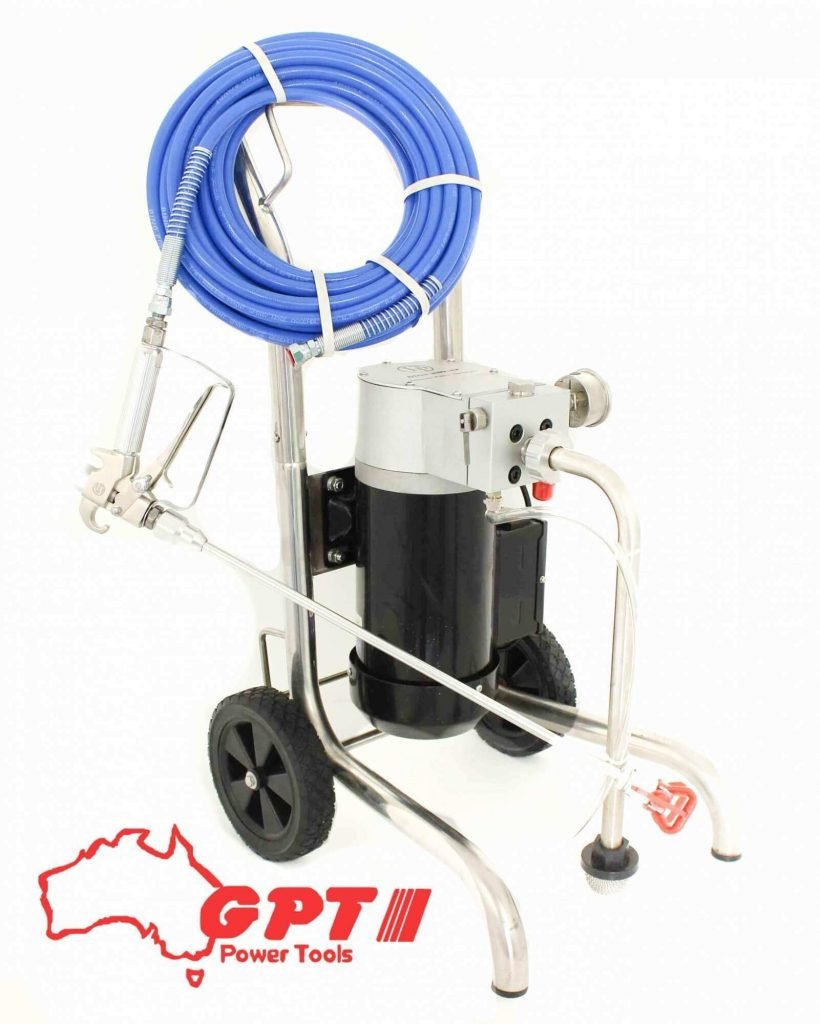
For interior and exterior house painting, an airless sprayer that accepts tips in the 0.015 to 0.019 in range covers standard acrylic and latex paint. Check the maximum tip size the unit accepts, because that sets the heaviest coating it can spray. The GPT Tools 5 HP airless unit accepts tips up to 0.019 in, which covers stains through to acrylic wall paint.
Check the paint data sheet first, because it names the correct thinner and the maximum percentage. Add thinner in small increments, stir thoroughly and test the spray pattern on cardboard between each addition. Airless sprayers usually need no thinning at all. Over-thinning causes runs, poor coverage and can void the paint warranty.
Match the compressor’s free air delivery at your working pressure to the gun’s air consumption at that pressure, with some headroom. Comparing maximum pressure ratings alone is misleading. A compressor that cannot keep up will make the spray pattern fade and spit partway through a pass.
Flush the system with the correct solvent immediately after the last pass, before the paint can dry. On an airless unit, relieve the pressure before removing the tip or guard. Clean the tip, guard and filters separately rather than only flushing the pump. Dried paint inside the pump, hose or tip is the most common cause of sprayer failure.
Spitting usually means air is entering the fluid path or the flow is being interrupted. Common causes are a partly blocked tip or filter, unstrained paint, a loose fluid nozzle or packing, paint that is too thick to atomise, or a compressor that cannot maintain the required air delivery. Work through those in order before assuming the gun is faulty.
No. Spraying 2-pack isocyanate paint requires a full-face airline respirator meeting AS/NZS 1716, a fully enclosed spray booth vented safely outside, and health monitoring including lung function testing. Isocyanate exposure can cause permanent respiratory sensitisation. This work belongs in a properly equipped commercial booth.
Hiring is cheaper for a single project. Buying usually works out cheaper once you spray more than about once a year, because hire fees accumulate and a hire unit still has to be cleaned and returned each time. Owning a sprayer also means you keep the same tips and settings, which shortens setup on every job after the first.
Paint Sprayers and Spray Guns at GPT Tools
-
5 HP- 5000 NEW AIRLESS PAINT SPRAYER SPRAY GUN+2 X 500 MM WAND 5/15 /17/ 19 / 6/21
Original price was: $690.00.$590.00Current price is: $590.00. Inc. GST -
AIRLESS PAINT SPRAYER
Original price was: $600.00.$590.00Current price is: $590.00. Inc. GST -
Gravity Feed Spray Gun
Original price was: $90.00.$60.00Current price is: $60.00. Inc. GST