

Firefighting Pump Buying Guide: Preparing Your Property for Bushfire Season
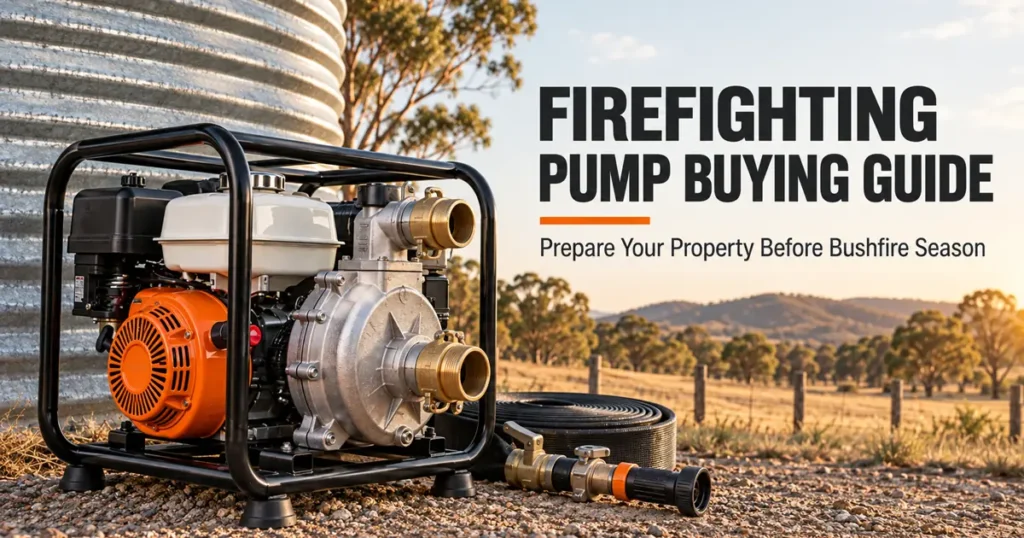
A firefighting pump is a high-pressure water pump that runs independently of mains power and pushes water from a tank, dam or pool through a hose. It is property preparation equipment. Size it from your water supply, your hose run and what the CFA requires, then test it before every season.
KEY TAKEAWAYS
- CFA says you need at least 10,000 litres of water independent of mains supply, and recommends closer to 40,000 litres.
- The pump should be non-electrical. CFA prefers petrol or diesel, because mains power will likely be lost. An electric pump needs a generator behind it.
- All pipes and valves between the water supply and the outlet must be at least 65 mm internal diameter, per CFA.
- Use fire-resistant hose and metal fittings. Garden hose and plastic fittings melt.
- CFA strongly advises that you do not stay to defend your property. A pump prepares a property. It does not make staying safe.
What a Firefighting Pump Is For, and What It Is Not
A firefighting pump is for preparing and protecting property. It is not equipment that makes staying to defend your home safe, and it should never be bought on that basis.
This has to come first, because it changes what you buy and why. CFA strongly advises that you do not stay to defend your property. CFA also says never to plan to stay and defend on Catastrophic fire danger days.
A pump does real work inside that advice. It wets down a structure and garden before a front arrives. It runs roof and garden sprinklers, and fills gutter plugs so the gutters hold water against ember attack.
It also puts out spot fires from embers after the front has passed, which is when many houses are actually lost. It gives attending firefighters a water supply to draw from. And it transfers water around the property for the rest of the year.
This guide is written for rural and acreage property owners, farmers, lifestyle block owners, and the landscapers and maintenance contractors who prepare those properties. It assumes a property with its own water supply and no reliable mains pressure in an emergency.
Fire Danger Ratings run from Moderate through to Catastrophic, and the rating is declared daily. During the declared Fire Danger Period, and on days of Total Fire Ban, restrictions apply to equipment use as well as to burning off. Check your district rating before any work that could start a fire.
What it does not do is protect a person. Equipment reduces some risk to property. It does not make defending a house safe, and no pump specification changes that. Your bushfire survival plan, and leaving early, sit above every decision in this guide.
How Much Water Do You Need?
CFA says you need at least 10,000 litres, held independently of mains water. It recommends closer to 40,000 litres, because many people defending homes have needed more.
Mains pressure may fail in an emergency, so the supply has to stand on its own. That is why the volume question comes before the pump question: the pump is sized to move the water you have to where it is needed.
Tank material matters as much as volume. CFA advises galvanised iron or concrete tanks, because plastic tanks can melt in heat. A dam or a swimming pool also works as a static supply.
Use this table to work out whether your supply is a starting point or already adequate.
| Water supply | Volume | What it supports |
|---|---|---|
| Below 10,000 L | Under the CFA minimum | Not enough on its own. Treat it as a top-up and plan more storage |
| 10,000 L | CFA minimum | The baseline CFA states for property defence preparation |
| 40,000 L or more | CFA recommended | Closer to what people defending property have actually needed |
| Swimming pool | Varies | A static supply a portable pump can draw from |
| Dam | Varies | A static supply, and large enough to refill fire tankers in many cases |
Petrol, Diesel or Electric?
Choose a non-electrical pump. CFA prefers petrol or diesel, because mains power will likely be lost in a fire. An electric pump only qualifies with a generator behind it.
This single requirement settles the power source question before any specification is compared. A pump that stops when the power goes out is not a firefighting pump on the day it matters.
| Petrol | Diesel | Electric | |
|---|---|---|---|
| Independent of mains power | Yes | Yes | No, unless a generator runs it |
| CFA position | Non-electrical preferred | Non-electrical preferred | Needs a generator |
| Typical use | Portable property preparation | Larger or fixed installations | Tank and transfer duties |
| Starting | Recoil or electric start | Usually electric start | Switch |
| Practical note | Lightest to move and the common choice for acreage | Heavier, longer run times | Fine year round, not for fire duty on its own |
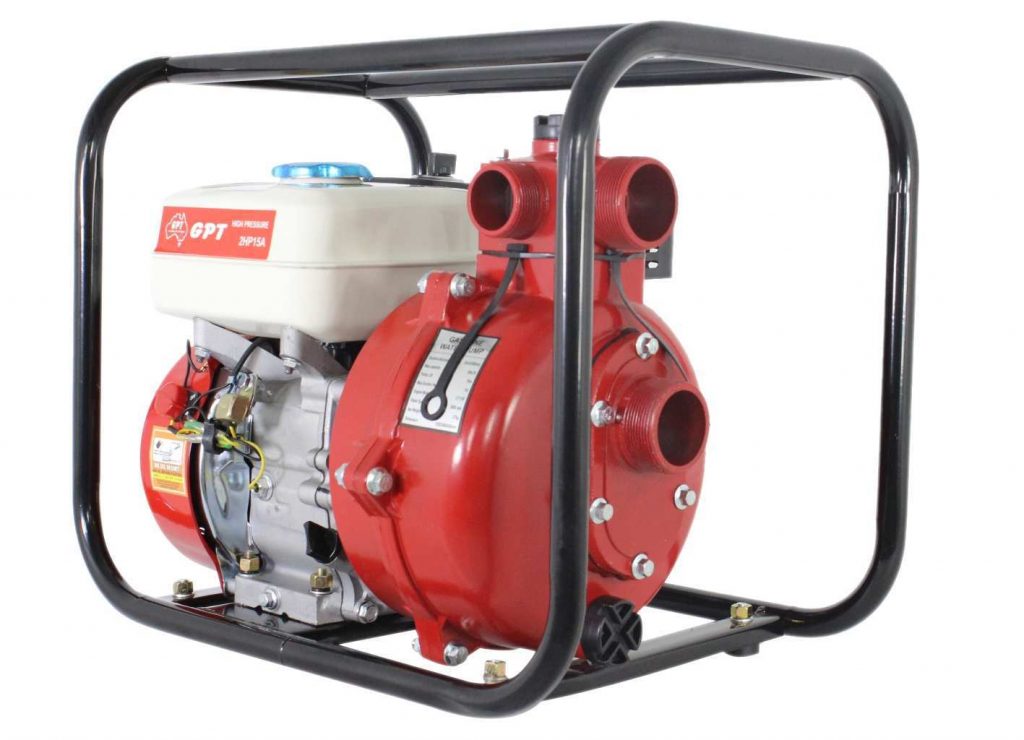
The firefighting pumps GPT Tools stocks are petrol twin impeller units. A twin impeller pump pushes water through two stages instead of one, which builds the higher pressure fire duty needs. It is explained in full under pump sizing below.
Petrol means they meet the CFA requirement for independence from mains power. There is no diesel firefighting pump in the range. Electric pumps in the electric pumps range are tank and transfer units, not fire duty pumps.
What Size Pump: Flow, Pressure and Head
Size the pump by its duty point, which is the flow it still delivers at the pressure you actually need. Peak flow and peak pressure are never achieved at the same time.
Three figures describe a pump. Flow is the volume it moves, in litres per minute or cubic metres per hour. Pressure is quoted in kilopascals or psi. Head is how high it can push water, in metres, and is another way of expressing the same pressure. Suction lift is how far above the water surface the pump can sit and still draw.
Two smaller specifications are worth checking. Electric start helps when you are working under stress, because a recoil start is harder to manage with adrenaline up and gloves on. Fuel tank capacity sets run time between refills, which matters when you are patrolling for embers over hours rather than minutes.
The trade-off is the part that catches people out. Flow and pressure work against each other. A pump quoted at a high maximum flow reaches that figure at almost no pressure, and reaches its maximum pressure at almost no flow. What matters is the duty point in between.
Two things pull the duty point down in a real setup. Height costs pressure: every metre you lift water uses part of the pump’s head. Hose length costs pressure through friction, so a long run arrives at the nozzle weaker than a short one. Size for the longest run and the highest point on your property, not for the easiest case.
Single or Twin Impeller
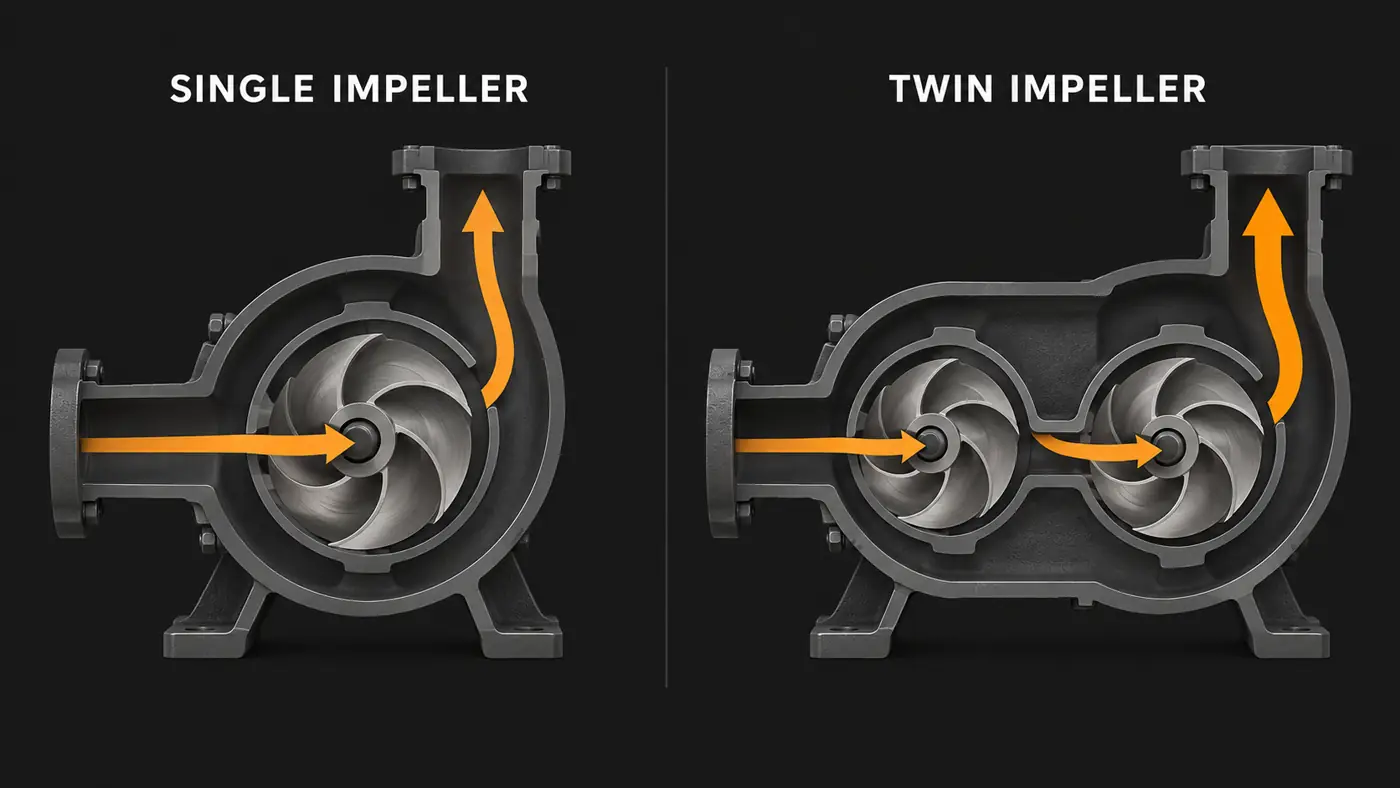
An impeller is the spinning disc that moves water. A single impeller pump passes water through once. A twin impeller pump passes it through two stages in series, so the second stage adds pressure to water that is already moving.
Twin impeller pumps are a two-stage design, and pumps with more stages are sold as multi-stage. The principle is the same: each stage adds pressure to water the previous stage has already moved.
That is why twin impeller pumps are the usual choice for fire duty. They produce higher pressure than a single impeller pump of similar engine size, which is what a long hose run and a roof sprinkler need. A single impeller pump moves more water at low pressure, which suits transfer rather than firefighting.
How Far a Pump Can Push Water
Head is the vertical distance a pump can lift water, quoted in metres at zero flow. Suction lift is the separate limit on how far above the water the pump itself can sit. Both are published by the manufacturer, and neither should be estimated.
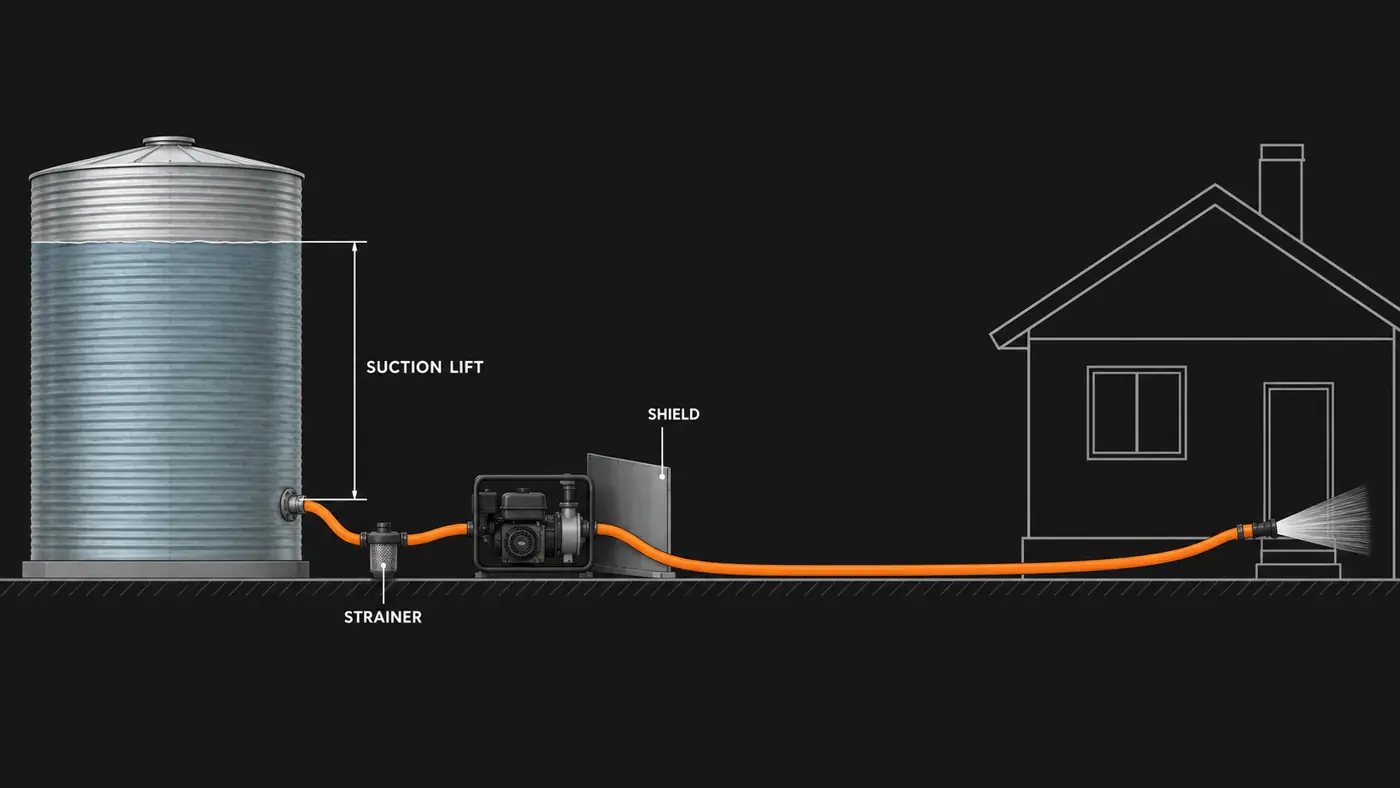
Mount the pump as close to the water surface as the site allows. Every metre of suction lift you avoid is pressure kept for the hose run. A pump sitting beside a tank outlet will always outperform the same pump placed up the hill.
These are the published figures for the firefighting pumps GPT Tools stocks. Where a page does not publish a figure, it is shown as not published rather than estimated.
| Product | Published performance | Notes |
|---|---|---|
| 7HP 2 in Twin Impeller Fire Fighting Pump | 18 m3/hr flow; 80 m maximum head; 7 m maximum suction lift; 38 mm suction; twin impeller; 24 kg | The product page spec table states 8 HP while the title states 7HP. Confirm the engine size with GPT Tools before relying on it |
| 7HP Twin Impeller Fire Fighting and Water Transfer Pump | 7 HP; twin impeller; 29.5 kg. Flow, pressure, head and suction lift are not published | Dual duty pump for firefighting and water transfer. Ask GPT Tools for the duty-point figures before sizing a hose run around it |
| 7 HP 3 Inch Water Pump | 7 HP; 3 inch | A transfer pump rather than a fire duty pump. Useful for moving volume between tanks |
Hose, Fittings and Pipework
Use fire-resistant hose and metal fittings. CFA states that garden hoses are made of plastic and can melt in a fire, and that metal fittings will not melt and resist damage and corrosion.
This is the cheapest part of the system to get right and the most common place people cut corners. A pump that works perfectly is useless behind a hose that has softened.
CFA also sets the pipework requirement. All pipes and valves between the water supply and the outlet must be at least 65 mm internal diameter. Above-ground pipes should be copper, brass or steel. Plastic pipe has to be covered or buried.
| Component | What CFA advises | Why |
|---|---|---|
| Hose | Fire-resistant hose rather than garden hose | Garden hose is plastic and can melt in a fire |
| Fittings | Metal rather than plastic | Metal lasts longer, will not melt, and resists damage and corrosion |
| Pipes and valves | At least 65 mm internal diameter | Smaller pipe throttles the supply before the pump can use it |
| Above-ground pipe | Copper, brass or steel | Plastic must be covered or buried to survive heat |
| Tank | Galvanised iron or concrete | Plastic tanks can melt in heat |
Lay flat hose is the common fire-duty choice because it stores compactly and handles pressure. GPT Tools stocks 2 inch lay flat hose in 100 metre lengths and a 3 inch lay flat hose with fittings in 25 metre lengths. Match the hose and fittings to your pump outlet rather than adapting down, because every reduction costs pressure.
Check the fitting type as well as the material. Camlock fittings connect and release quickly under pressure, which suits fire duty, while BSP threaded fittings are common on tanks and transfer work. Decide which standard your system uses and keep to it, because every adapter is another leak point and another pressure loss.
Fit a strainer on the suction line. It keeps leaves, silt and debris out of the impeller, and a blocked or damaged impeller is the most common way a pump fails on the day it is needed. A foot valve on the end of the suction line holds water in the line between starts, which makes re-priming faster.
Setting Up with a Tank, Dam or Pool
Draw from a static supply: a tank, dam or swimming pool. Keep the pump close to the water surface, fit a strainer, and run the shortest practical hose to where you need pressure.
A static water supply is simply water that stays on the property and does not depend on mains pressure. A rainwater tank, a dam and a backyard pool all qualify. The pool is the one people forget, and NSW RFS describes a backyard swimming pool as an ideal static water supply for small portable pumps.
In New South Wales, you can register that supply. NSW RFS runs a Static Water Supply programme for supplies of more than 3,000 litre capacity. It covers property dams that can refill fire tankers and aircraft, backyard pools, and tanks fitted for firefighting.
The RFS provides specially designed SWS signs so crews can find the supply. Victoria does not run the same scheme. Victorian owners should instead make the supply obvious and accessible to a truck.
Set the system up so it can be started quickly and by someone who did not install it. Label the valves, leave the hose connected, and keep fuel stored safely nearby.
Where to Position and Shield the Pump
Put the pump close to the water, low to the ground and protected from radiant heat. CFA states that the pump must be protected from radiant heat to keep working.
Radiant heat, not direct flame, is what usually stops equipment. A pump sitting exposed on the fire-facing side of a tank can fail before the front reaches the property.
Shield it with a non-combustible barrier such as a masonry wall, a metal screen or the tank itself between the pump and the likely fire approach. Keep the area around the pump clear of fuel: no mulch, long grass, stacked timber or jerry cans beside it. Leave enough space to start and refuel it without moving the shield.
Keep the pump where someone can reach it safely. A pump in a position you would not want to stand in during a fire is a pump you cannot use.
Testing, Maintenance and Off-Season Storage
Test the equipment before each bushfire season. CFA states this plainly, and a pre-season test is the difference between owning a pump and having a working one.
Run the pump for several minutes under load, not just until it starts. Check that it primes within its usual time, holds pressure at the nozzle, and does not overheat. Walk the hose run and look for perished sections, and check every fitting for corrosion.
Fuel is the common failure. Petrol degrades within weeks, so rotate it rather than leaving the same tank in place all year. Drain or stabilise the fuel before storing the pump for the off-season, and store fuel in an approved container away from the pump.
Clean the strainer and the suction line after use, because silt left in the line dries hard. Store the pump dry and under cover, and run it briefly every few months so the seals do not dry out.
Use this checklist before each season.
| Check | What good looks like |
|---|---|
| Start and run under load | Starts within a few pulls and runs steadily for several minutes |
| Priming | Draws and holds prime within the usual time for the pump |
| Pressure at the nozzle | Strong, steady stream at the far end of the full hose run |
| Hose | No perished, cracked or softened sections anywhere along the run |
| Fittings | Metal, tight, no corrosion, no weeping joins |
| Strainer | Clean and clear of silt, leaves and debris |
| Fuel | Fresh, rotated this season, stored in an approved container |
| Access and shielding | Pump clear of fuel loads, shield in place, valves labelled |
Getting Ready Before the Season
Work through it in order. Confirm your water volume against the CFA figures. Choose a non-electrical pump sized to your longest hose run and highest point. Fit fire-resistant hose and metal fittings, shield the pump, then test the whole system before summer.
Browse the firefighting pumps and lay flat hose range, or contact the team to match a pump to your tank, dam or pool and the distance you need to cover. Australia-wide delivery is available on eligible products.
Two things sit outside this guide. If your property is in a designated bushfire-prone area or carries a bushfire overlay, construction requirements are set separately by AS 3959. They are expressed as a BAL rating for the building, not by the equipment you own.
Clearing and maintaining an Asset Protection Zone around the house is likewise a planning and vegetation question rather than a pump question. Both are worth confirming with your council and fire service.
The water and equipment figures in this guide are CFA Victoria’s. Other states publish their own equivalent guidance, and NSW RFS and Fire and Rescue NSW both cover static water supplies for firefighting access. Check the advice issued by the fire service for your own state.
Then write or review your bushfire survival plan with your state fire service. CFA’s position is that your life is more important than your property, and no equipment on this page changes that.
Frequently Asked Questions
Fill the pump casing with water through the priming plug until it is full, close the plug, then start the engine with the outlet open so air can escape. A self-priming pump will draw the remaining air out of the suction line itself once the casing is wet. Never run a pump dry, because the seal relies on water for cooling and will be damaged in minutes.
Test it before each bushfire season, which is what CFA advises. Run it under load for several minutes rather than just starting it, and check pressure at the far end of the full hose run. Starting it briefly every few months through the year keeps the seals from drying out and makes the pre-season test less likely to find a problem.
Yes, and it is one of the better arguments for owning one. A twin impeller pump will move water between tanks, fill a spray unit or run paddock watering through the year. Running it regularly also means you know it works. Flush it with clean water after any dirty or silty duty.
In New South Wales, you can register a supply of more than 3,000 litre capacity with the NSW RFS Static Water Supply programme. The RFS provides a sign so crews can find it. Registration is not compulsory. Victoria does not run the same scheme, so make the supply accessible and obvious to an attending truck instead.
No. CFA strongly advises that you do not stay to defend your property, and says never to plan to stay and defend on Catastrophic fire danger days. A pump helps you prepare a property, wet it down, patrol for embers afterwards and supply attending firefighters. It does not make you safe, and it should not be the reason anyone changes their plan.
Drain or stabilise the fuel, because petrol degrades within weeks. Clean the strainer and flush the suction line so silt does not dry inside it. Store the pump dry and under cover, with the hose coiled loosely rather than folded in the same place each time. Start it briefly every few months.
Firefighting Pumps and Hose at GPT Tools
-
7HP -2ʼʼ TWIN IMPELLER FIRE FIGHTING PUMP FIREFIGHTING | PETROL WATER PUMP
Original price was: $550.00.$300.00Current price is: $300.00. Inc. GST -
7HP TWIN IMPELLER FIRE FIGHTING & WATER TRANSFER PUMP FIREFIGHTING
Original price was: $550.00.$399.00Current price is: $399.00. Inc. GST -
7 HP 3 Inch Water Pump
Original price was: $550.00.$400.00Current price is: $400.00. Inc. GST