

Cement Mixer Buying Guide: Choosing the Right Size for Your Concreting Job
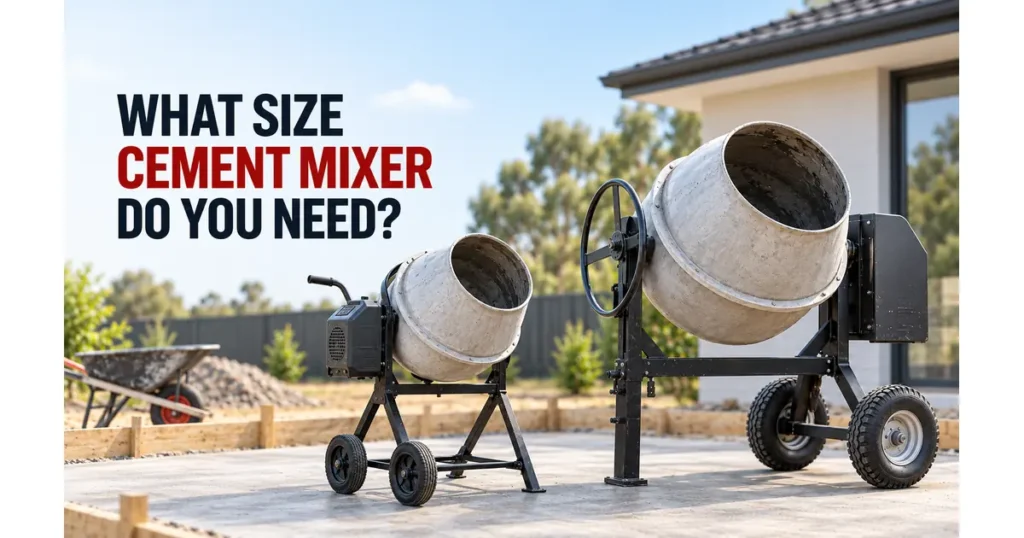
A cement mixer is a rotating drum that blends cement, sand, aggregate and water into concrete on site. The number on the drum is its total volume, not how much concrete it will mix in one go. Size the mixer from the volume of your pour, then check how many drum-loads, or batches, that means.
KEY TAKEAWAYS
- Drum capacity is not batch size. A drum needs empty space above the mix to tumble, so usable mixing capacity is always well below the number on the drum.
- Work out your pour in cubic metres first, then bags, then batches. On Cement Australia’s stated coverage, a 20 kg bag of Concrete Mix yields about 8.4 litres, or close to 119 bags per cubic metre. Yields vary by brand, so read your bag.
- Electric suits suburban jobs near a power point. Petrol suits sites with no mains power.
- Past roughly half a cubic metre in one continuous pour, ready-mix or mini-mix delivery usually beats batching by hand.
- WorkSafe ACT names mixing concrete among the jobs that expose people to silica dust. Wear a P2 respirator, gloves and eye protection, and keep the dust damp.
What a Cement Mixer Does, and When You Need One
A cement mixer earns its place once you need more concrete than you can mix by hand and still place before it starts to stiffen. Below that, a wheelbarrow and a shovel will do.
Worth clearing up first: cement and concrete are not the same thing. Cement is the grey powder that acts as the glue. Concrete is the finished material, made of cement, sand, coarse aggregate and water. A cement mixer makes concrete, and most people search for it under both names, so a concrete mixer and a cement mixer are the same machine.
Pre-mixed concrete, usually sold as premix in 20 kg bags, already contains the cement, sand and aggregate. You add water. Post mix is a different product again: a rapid-set blend designed to be poured dry into a post hole and wetted, which is why it suits fence posts and suits them only.
A mixer is worth it for footings, a shed or tank base, a small slab or pad, a path, steps, retaining wall footings, or a run of post holes. The test is simple: if mixing by hand would become the slowest part of the day, use a mixer. It also gives a more consistent mix than a shovel, which matters more than most people expect.
This guide is written for owner-builders and DIY renovators, and for the concreters, fencing contractors, landscapers, bricklayers and small builders who mix on site rather than order a truck. It assumes small to medium pours you place yourself.
One alternative is worth knowing before you buy a drum at all. A paddle mixer is a high-torque drill that spins a stirrer in a bucket or tub, rather than tumbling material in a drum. It suits mortar, render, tile adhesive and small batches where a drum mixer is more machine than the job needs, and it cleans up in a fraction of the time.
GPT Tools lists an OX 1600 W mixing drill with a mixing paddle. The manufacturer states 1600 W, two no-load speed ranges of 180 to 400 rpm and 300 to 700 rpm, and an M14 threaded bit holder. For concrete in any volume, though, a drum mixer is still the right tool.
Drum Capacity Is Not Batch Size
This is the single thing most buyers get wrong, and it is the reason mixers get bought too small.
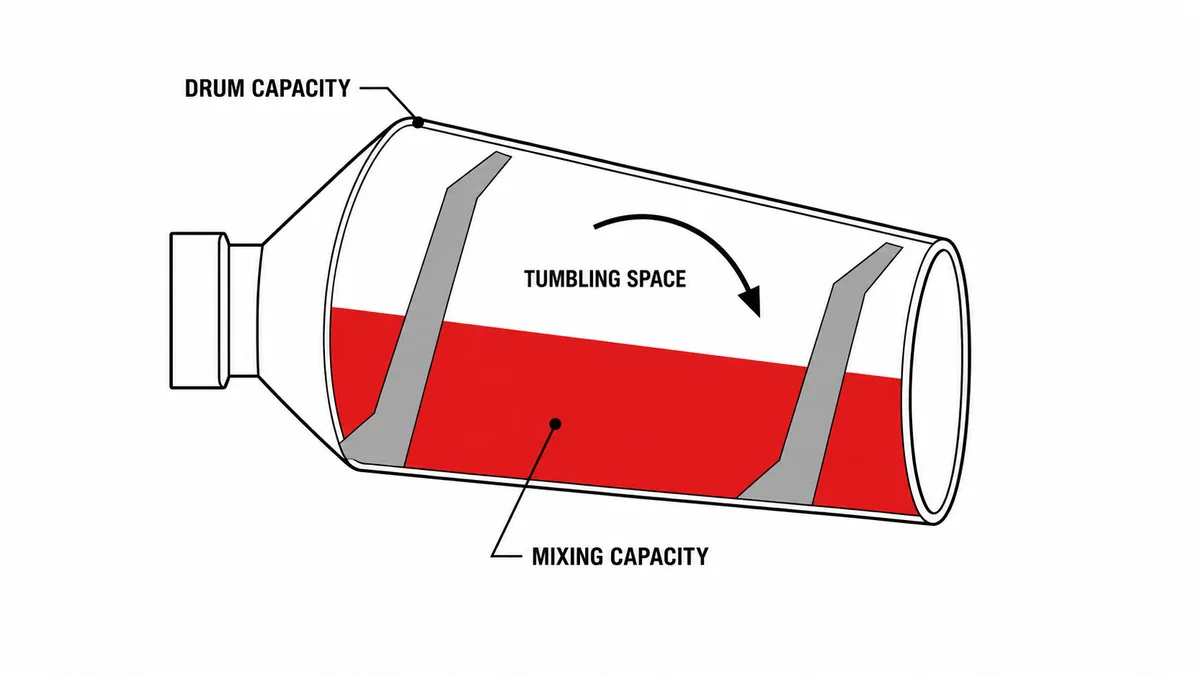
Drum capacity is the total internal volume of the drum, measured in litres. It is the number used in the product name.
Usable mixing capacity is how much wet concrete the drum will actually turn in one batch, meaning one drum-load mixed and discharged. It is always well below the drum capacity.
The reason is mechanical rather than marketing. A drum mixes by tumbling: material has to fall through open space inside the drum to fold together.
Fill it to the brim and nothing tumbles. The mix stays uneven, the motor labours, and material slops out of the opening as the drum turns. A tilting drum, meaning one that tips forward to pour the mix out, also has to be angled down to discharge, which costs more headroom again.
So treat the drum figure as a size class, not a batch size. Before buying, look for the manufacturer’s stated mixing or working capacity rather than the drum rating. If a listing quotes only drum capacity, ask for the mixing capacity before you size your job around it.
Working Out What Size You Need
Work in three steps: volume, then bags, then batches. The batch count is the number that tells you whether a mixer suits the job at all.
Start with volume in cubic metres. Multiply length by width by depth in metres. A path 10 m long, 0.9 m wide and 0.1 m thick is 10 x 0.9 x 0.1, or 0.9 cubic metres. Add a little for spillage and uneven ground.
Then convert to bags. Yield varies by product, so read the bag rather than assume. As a worked example, Cement Australia states that two 20 kg bags of its Concrete Mix cover approximately a 450 x 500 mm slab at 75 mm thick.
That is 0.0169 cubic metres for two bags, so roughly 8.4 litres per bag, or close to 119 bags per cubic metre. Other brands differ, and the figure on your bag wins.
Then convert to batches. Divide the concrete you need by the mixer’s stated mixing capacity, not its drum capacity. That gives the number of times you load, mix, discharge and reload. Use this table to see what the batch count means in practice.
| Job | Rough volume | What it means for mixing |
|---|---|---|
| A few fence post holes | Under 0.1 m3 | Easily inside a small mixer, or premix in a barrow |
| Strip footing for a small shed | 0.1 to 0.3 m3 | Comfortable mixer work in a single session |
| Shed or tank base, small path | 0.3 to 0.5 m3 | Workable, but plan the batches and have a second pair of hands |
| Driveway, larger slab | Over 0.5 m3 | Batching becomes the bottleneck. Price ready-mix or mini-mix first |
Two practical limits sit behind that table. Each batch takes time to load, mix and discharge, and a long run of batches turns a morning into a day. More importantly, concrete placed well apart in time does not knit together, which leaves a cold joint through the pour. For anything that has to be structurally continuous, the batch count matters more than the drum size.
When to Stop Mixing and Order Ready-Mix
Past roughly half a cubic metre in one continuous pour, delivered concrete usually beats batching by hand. That is the honest limit of a site mixer, and knowing it saves more money than choosing between two drum sizes.
Ready-mix is concrete batched at a plant to a specified mix and delivered by agitator truck, normally sold by the cubic metre with a minimum load. Mini-mix is the same idea in a smaller truck, which suits tight access and smaller volumes where a full load would be wasted.
Three things push a job toward delivery. Volume, because the batch count climbs fast. Continuity, because a slab or structural footing wants to go in as one pour. And specification, because a supplier can batch to a stated strength and slump. Slump is the measure of how wet and workable the mix is, and site-batching cannot match a supplier for either.
A mixer still earns its keep alongside delivery. It handles the parts a truck cannot reach, the mortar and render on the same site, repairs and top-ups later, and the post holes and footings that come before the main pour.
Electric or Petrol
Choose electric if the job is within reach of a power point, and petrol if it is not. Everything else about the decision follows from that.
| Electric | Petrol | |
|---|---|---|
| Best for | Suburban jobs, garages, sites with mains power | Paddocks, rural blocks, early-stage sites with no power on |
| Running | Plug in and go, no fuel to store or mix | Fuel and oil to manage, plus engine servicing |
| Noise and fumes | Quieter, no exhaust, usable in partly enclosed spaces | Louder, and exhaust means it must stay outdoors |
| Setup | Needs a lead rated for the run and an RCD on site | Self-contained, moves anywhere on the block |
| Maintenance | Motor, belt and bearings | Engine, belt and bearings |
A long extension lead costs voltage over distance, which makes a motor work harder and run hotter. If the pour is a long way from the board, either run a heavier lead rated for the distance or use petrol. Never run a petrol engine inside a shed or garage.
On a block with no mains connection at all, the question stops being which mixer and starts being where the power comes from. A petrol generator sized to the mixer’s rated input is the usual answer, and it powers the rest of the tools on site as well. Size it above the motor rating, because an electric motor draws more on start-up than it does running.
Drum, Frame and Motor
Once the size is settled, four build details decide whether a mixer is pleasant to use or a daily argument: the drum material, how it discharges, how it moves, and what drives it.
Steel or poly drum
Steel drums take knocks and scraping without deforming, which suits site work and anyone chipping out set material. Poly drums are lighter and will not rust, and set concrete tends to release more easily from the surface, which makes cleaning quicker. Steel is the harder wearing of the two. Poly is the easier to live with.
Tilting or reversing drum
A tilting drum is angled down by hand to pour the mix out of the drum opening. That gives controlled discharge straight into a barrow, and it is the common arrangement on small and mid-size mixers.
A reversing drum stays in place, and the rotation direction is reversed to discharge. That is faster and suits heavier continuous work. For most small concreting jobs, a tilting drum is the practical choice.
Frame, wheels and portability
Most small mixers sit on a fixed stand with two wheels, which you tip and roll like a barrow to reposition. That suits a job where the mixer stays near the pour.
A wheelbarrow mixer puts the drum, or bowl as some listings call it, on a barrow frame so the same machine mixes and carries the batch to where it is going. It is the portable option, and it earns its keep on sites where the pour moves around, such as a run of post holes along a fence line. The trade-off is a smaller batch and more trips.
Larger towable, pan and forced action mixers exist for commercial volumes and stiff mixes. They sit well outside a small concreting job and are usually hired rather than bought.
Motor power and drive
Motor power decides how wet and heavy a mix the drum can keep turning when it is full. An underpowered motor will turn an empty drum happily and then stall or overheat under load, which is the moment it matters. Compare the manufacturer-stated motor rating in watts or kilowatts, and treat horsepower figures with care unless the listing states both.
Ask about duty cycle too, meaning how long the motor is rated to run continuously before it needs to rest. A long pour is continuous work, and a mixer rated for intermittent use will overheat partway through a session.
Most small mixers drive the drum through a belt. A belt is a wear part and needs its tension checked periodically. That is worth knowing before buying second-hand, because a mixer that will not turn is often a belt or a motor rather than a dead machine.
GPT Tools lists a replacement 240 V cement mixer motor rated by the manufacturer at 0.75 kW and 950 rpm, to suit a 3.5 cubic foot drum. The same listing also describes it as 3 hp, which does not match 0.75 kW. Confirm the rating against your mixer before ordering.
Silica Dust, Cement Burns and PPE
Mixing concrete carries two health risks that are easy to miss because neither hurts at the time: silica dust in the lungs and cement burns on the skin.
Respirable crystalline silica, usually shortened to RCS, is the fine fraction of silica dust small enough to reach deep into the lungs. WorkSafe ACT states that concrete and autoclaved aerated concrete typically contain around 20 to 40 per cent silica, and names cutting and mixing concrete among the activities that expose workers to it.
The national exposure limit is set by Safe Work Australia, which states that the workplace exposure standard for RCS is 0.05 mg per cubic metre as an eight-hour time-weighted average. Its recommended controls are water suppression, on-tool dust extraction or local exhaust ventilation, together with respiratory protection.
On a mixer, that translates into a few habits. Tip dry bags slowly and close to the drum rather than from height. Add the water first where the manufacturer’s instructions allow it, so the powder wets as it goes in. Stand upwind. Keep the mix damp rather than letting dry material blow about, and wear a P2 respirator while handling dry powder.
Wet concrete is the second risk and the one people underestimate. It is strongly alkaline, and prolonged skin contact causes cement burns and dermatitis, which can develop through wet clothing without any immediate pain. Wear waterproof gloves, keep sleeves down, and change out of anything that gets soaked with slurry rather than working in it. Rinse splashes off skin promptly.
Also treat the machine itself with respect. A rotating drum will catch a glove, a sleeve or a hand tool, so never reach into a turning drum and never leave guards off the drive. On mains power, use an RCD, keep leads out of water and off the traffic path.
This is general information only. Follow the manufacturer’s manual for your mixer and read the safety data sheet for the product you are mixing. Check the requirements of your state work health and safety regulator as well, because they differ by state and by whether the work is commercial.
Mixing and Cleaning
Load the drum in the right order, mix for long enough to get a consistent batch, and clean the drum before anything sets. Those three habits decide how long a mixer lasts.
Order matters more than people expect. Cement Australia instructs that you add the water to the mixing vessel first, then empty the concrete mix blend slowly into the water and mix thoroughly. Any extra water goes in at roughly 100 ml at a time.
Putting dry material in first tends to pack it into the back of the drum, where it sits unmixed.
Mix each batch until the colour and texture are even throughout, with no dry pockets and no streaks of neat cement. Cement Australia describes the target consistency simply: wet concrete should hold its shape when it is squeezed in a gloved hand.
Resist adding water to make the mix easier to handle. The water-cement ratio, meaning the amount of water relative to cement, is what sets the final strength. More water means easier placing and weaker concrete.
If you are batching from raw materials rather than premix, you are working to a nominal mix ratio: parts of Portland cement to sand to coarse aggregate, measured by volume. Ratios differ by application, and a structural pour has a specified strength that a site-batched mix cannot be assumed to meet. Follow the ratio specified for your job, and use premix or delivered concrete where strength has to be demonstrated.
Discharge straight into a barrow positioned under the drum opening rather than shovelling it out, and keep the barrow moving so the mix does not sit and stiffen.
Clean the drum before you stop. Run clean water and a few shovels of coarse aggregate in the turning drum to scour the walls, tip it out, then hose down the drum lip and blades. Set concrete left in a drum is very hard to remove, and it is the usual reason a second-hand mixer is worthless.
Hire or Buy
Hire for a single job. Buy once mixing is a regular part of your work, or once the hire fees over a year start to look like the price of a machine.
Cement mixer hire is widely available and cheap for a day or a weekend, which makes it the sensible option for a one-off pour. The maths turns once you are hiring two or three times a year.
| Consider hiring when | Consider buying when |
|---|---|
| You have one pour and no plans for another | You pour footings, posts or pads through the year |
| You need a larger mixer than you would ever own | You run mortar or render on the same sites |
| You have nowhere to store and clean a mixer | Travel to and from a hire branch costs you half a day |
| The job is a one-off repair or extension | You want a machine you know has been cleaned properly |
One practical point in favour of owning: a hired mixer arrives in whatever state the last user left it, and a drum with set concrete around the blades mixes poorly. If you hire, check the drum before you load it.
Choosing Your Mixer
The decision comes down to one number, and it is not the one on the drum. Work out your batch count, then be honest about whether you can place that many loads while the first ones are still workable. If you cannot, price delivered concrete before you price a mixer.
If you can, buy the most capable mixer the job and your budget justify. Check the manufacturer’s stated mixing capacity rather than the drum rating. Then set aside ten minutes at the end of every pour to wash it out.
Not sure which size suits your job? Call GPT Tools on (03) 9357 6168 or contact the team with your pour dimensions, and they can talk it through with you. You can also call in at the Campbellfield shop in Melbourne.
The cement mixers and concreting range sits within the wider construction equipment and parts and accessories categories. Delivery, returns and payment terms are set out on the customer service page.
Frequently Asked Questions
Mix until the batch is even in colour and texture with no dry pockets, which on a small mixer is usually a few minutes once all the material is in. Judge it by the mix rather than the clock, and follow the time on the bag or in the manual where one is given. Over-mixing a batch is less damaging than under-mixing it.
For small volumes, mixing your own is almost always cheaper, because a delivery has a minimum load and you pay for what you do not use. The crossover is not really about price per bag; it is about the batch count. Once a pour needs more batches than you can place while the first ones are still workable, delivered concrete wins on both cost and result. Price both for your actual volume before deciding.
It depends on the product, so read your bag. As a worked example, Cement Australia states that two 20 kg bags of its Concrete Mix cover approximately a 450 x 500 mm slab at 75 mm thick. That works out to roughly 8.4 litres per bag, or close to 119 bags per cubic metre. Treat any figure you find online as a starting estimate only.
Yes. A drum mixer will handle mortar and render as well as concrete, which is one of the reasons owning one pays off on a build. Mortar and render are finer mixes, so they need less time in the drum and a thorough wash-out afterwards, because fine material sets hard in the corners and around the blades.
Yes. Run a little water around the inside of the drum before the first load so the dry material does not grab the bare surface. A damp drum releases the mix more cleanly and makes the wash-out easier at the end. Tip the excess water out before you start loading, because it counts toward the water in your first batch.
On a belt-driven mixer, the usual causes are a slipped or broken drive belt, a seized bearing, or a failed motor. A drum packed with set concrete can stall a healthy motor too. Isolate the power before checking anything. Belts and motors are replaceable parts, so a mixer that will not turn is often repairable rather than finished.
Related Concreting Equipment at GPT Tools
-
3HPCement Mixer Electric Motor 240V
Original price was: $540.00.$250.00Current price is: $250.00. Inc. GST -
OX 1600W MIXING DRILL PRO w/ MIXING PADDLE & CARBON BRUSH SET
Original price was: $300.00.$280.00Current price is: $280.00. Inc. GST -
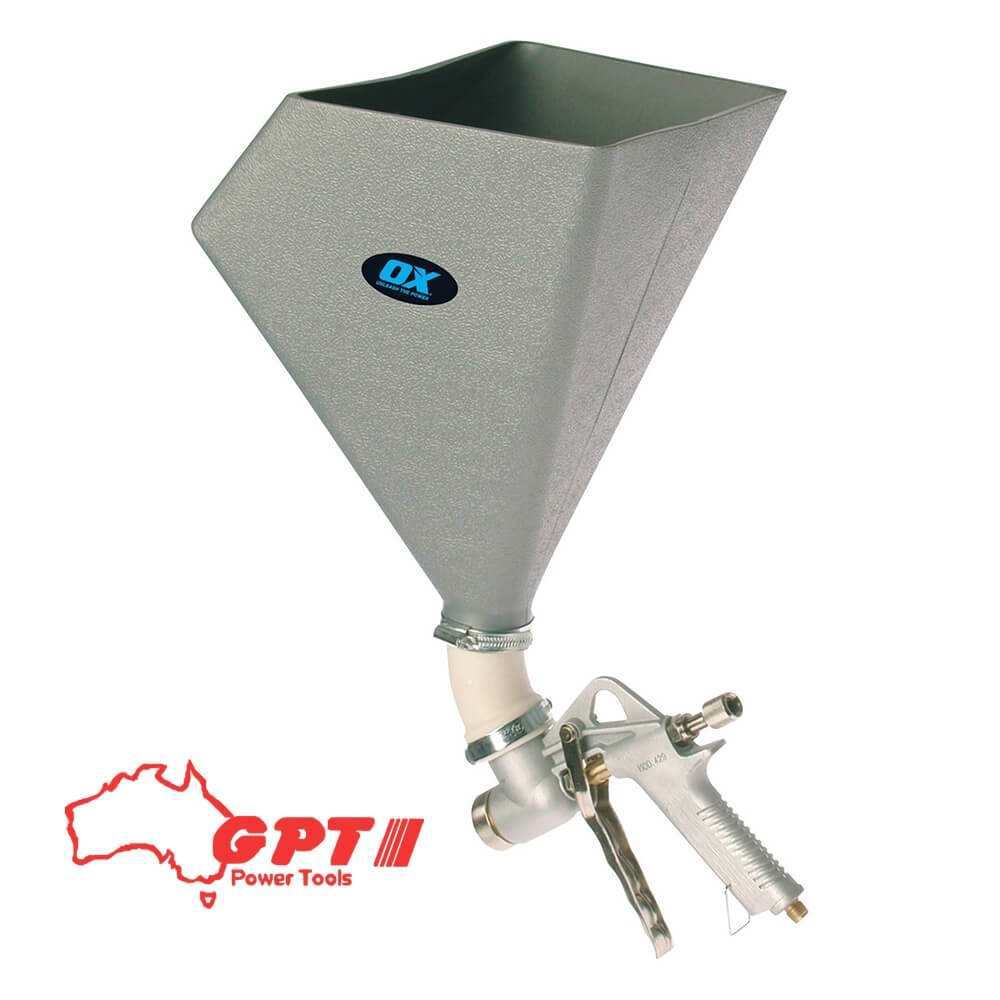
OX PROFESSIONAL 8L SQUARE HOPPER GUN TEXTURE GUN
Original price was: $225.00.$175.00Current price is: $175.00. Inc. GST