


Electric vs Petrol Pressure Washer: Which One Is Right for Your Job?
Which One Is Right for Your Job?
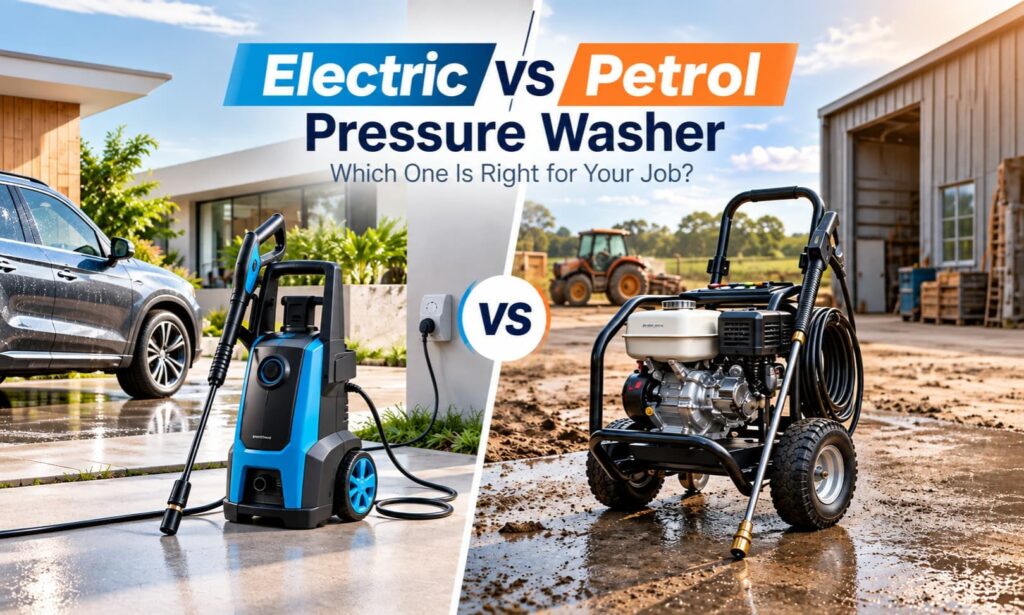
An electric pressure washer is the best choice for home cleaning, car washing, decks and patios where a power point is accessible. A petrol pressure washer delivers higher PSI and flow rate for heavy-duty work like stripping concrete, cleaning large driveways, commercial sites and remote properties without mains electricity. For most Australian homeowners, an electric model between 1400W and 2400W handles typical cleaning jobs. For tradies, farmers and commercial users, a petrol model with 3000+ PSI provides the power and portability needed for demanding work.
📋 KEY TAKEAWAYS |
|---|
| 1. Electric pressure washers deliver 1000 to 2600 PSI and suit car washing, decks, patios, outdoor furniture and light to medium home cleaning. 2. Petrol pressure washers deliver 2500 to 4200+ PSI and suit concrete driveways, commercial surfaces, paint stripping, farm equipment and remote site cleaning. 3. PSI (pounds per square inch) measures cleaning force. Flow rate (litres per minute) measures how fast the water rinses surfaces. Both matter when choosing a pressure washer. 4. Electric models are quieter, lighter, require less maintenance and produce no exhaust fumes, making them suitable for enclosed or semi-enclosed areas. 5. Petrol models are fully portable, self-priming capable (can draw water from tanks without mains pressure) and built for extended heavy-duty use. 6. Nozzle angle controls spray intensity. A 0-degree nozzle concentrates maximum force. A 40-degree nozzle provides wide, gentle coverage for delicate surfaces. |
This guide compares electric and petrol pressure washers across cleaning power, portability, noise, maintenance and cost. Browse the pressure washer range at GPT Tools to see current models.
What Is a Pressure Washer?
A pressure washer is a motorised cleaning tool that pumps water at high pressure through a concentrated nozzle to remove dirt, grime, mould, oil, paint and other contaminants from surfaces. Pressure washers are also called pressure cleaners, high pressure washers or water blasters.
The two main types available in Australia are electric pressure washers (powered by a 240V electric motor) and petrol pressure washers (powered by a four-stroke petrol engine). GPT Tools stocks both types along with pressure washer pumps and high pressure accessories.
Electric vs Petrol Pressure Washers at a Glance
| ELECTRIC PRESSURE WASHER | PETROL PRESSURE WASHER |
|---|---|
| ✓ Powered by 240V mains electricity ✓ 1000 to 2600 PSI cleaning power ✓ Quieter operation, no exhaust fumes ✓ Lighter and easier to move (5 to 15 kg) ✓ Low maintenance, no fuel or oil ✓ Best for home, car, deck and patio cleaning | ✓ Powered by 4-stroke petrol engine ✓ 2500 to 4200+ PSI cleaning power ✓ Fully portable, no power cord needed ✓ Heavier and more robust (25 to 50 kg) ✓ Self-priming: draws water from tanks ✓ Best for concrete, commercial and farm use |
Key Differences Between Electric and Petrol Pressure Washers
The main difference is the power source: an electric pressure washer plugs into a 240V power point, while a petrol pressure washer runs on a four-stroke engine. This affects PSI output, flow rate, portability, noise, weight and maintenance requirements.
| Feature | Electric Pressure Washer | Petrol Pressure Washer |
|---|---|---|
| Power source | 240V mains electricity | Four-stroke petrol engine |
| PSI range | 1000 to 2600 PSI | 2500 to 4200+ PSI |
| Flow rate | 5 to 8 L/min | 8 to 15 L/min |
| Motor/engine | 1200W to 3000W+ electric motor | 160cc to 390cc OHV petrol engine |
| Weight | 5 to 15 kg | 25 to 50 kg |
| Noise level | Quieter | Louder. Hearing protection recommended |
| Portability | Limited by power cord (typically 5 to 10 m) | Fully portable. No power needed |
| Fuel tank | N/A | 1 to 4 litres depending on model |
| Self-priming | Rarely | Yes. Can draw from tanks and buckets |
| Exhaust fumes | None | Yes. Outdoor use only |
| Best for | Cars, decks, patios, home cleaning | Concrete, driveways, commercial, farm |
| Maintenance | Minimal. Check hose and nozzle | Oil, spark plug, air filter, fuel system |
| Price range (AUD) | Approximately $100 to $500 for home models. $500 to $1,000+ for heavy-duty | Approximately $300 to $2,000+ depending on PSI and engine size |
When to Choose an Electric Pressure Washer
An electric pressure washer is the right choice for most Australian homeowners who clean cars, outdoor furniture, decks, patios, fences, driveways (light soiling) and house exteriors within reach of a power point.
| Safety: Always plug an electric pressure washer into a power point protected by a residual current device (RCD). RCD protection is essential when using electrical equipment in wet environments. Check your state or territory water restrictions before pressure washing, as some areas limit water usage during drought conditions. |
Car Washing and Detailing
Best choice: Electric pressure washer at 1200 to 1500 PSI. This PSI range removes road grime, mud and brake dust without risking damage to vehicle paintwork. Use a 25-degree or 40-degree nozzle to spread the spray and avoid concentrating force on panels. A foam cannon attachment improves pre-wash cleaning by lifting dirt before contact washing.
Decks, Patios and Outdoor Furniture
Best choice: Electric pressure washer at 1000 to 1800 PSI. Timber decking requires lower pressure to avoid splintering the wood grain. Concrete pavers, tiles and composite decking can handle slightly higher PSI. Use a 25-degree nozzle at a consistent distance to avoid leaving stripe marks on the surface.
House Exteriors and Fences
Best choice: Electric pressure washer at 1600 to 2400 PSI. Brick, render, weatherboard and Colorbond fences respond well to an electric pressure washer with detergent. Avoid using a 0-degree nozzle on painted surfaces or render, as concentrated force can strip paint and damage soft materials.
When to Choose a Petrol Pressure Washer
A petrol pressure washer is the right choice when you need higher PSI for heavy-duty cleaning, when you work on sites without mains electricity, or when you clean large areas that would take too long with a lower-powered electric model.
Concrete Driveways and Slabs
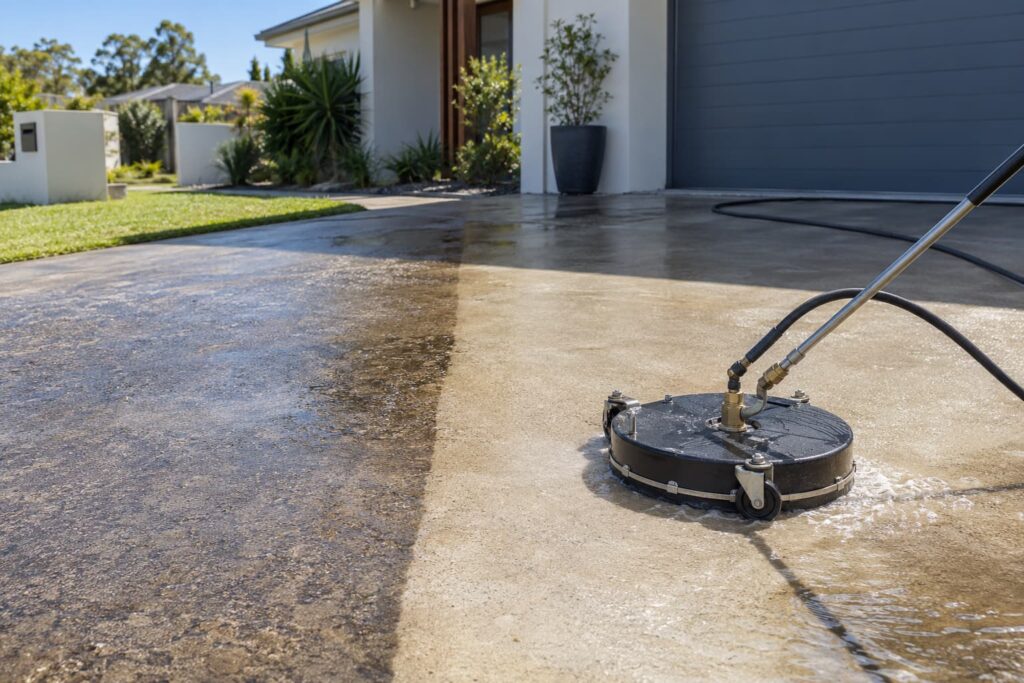
Best choice: Petrol pressure washer at 3000+ PSI. Concrete driveways with oil stains, tyre marks, mould and embedded dirt require high PSI and strong flow rate to clean effectively. A surface cleaner attachment speeds up flat concrete work and produces an even finish without stripe marks.
Commercial and Construction Cleaning
Best choice: Petrol pressure washer at 3500 to 4200 PSI. Builders, contractors and commercial cleaners need high-duty-cycle machines that can run for extended periods on large surfaces. Petrol models with triplex plunger pumps handle sustained commercial use better than axial cam pumps found in lighter models.
Farm and Remote Property Use
Best choice: Petrol pressure washer with self-priming pump. Farms, rural properties and remote sites often have no mains water or electricity. A self-priming petrol pressure washer draws water directly from a tank, dam or bucket, eliminating the need for a pressurised tap connection. This makes it the only practical option for cleaning machinery, livestock areas, sheds and equipment away from mains infrastructure.
How to Choose the Right PSI and Flow Rate
PSI (pounds per square inch) measures the force of the water hitting the surface. Flow rate (litres per minute) measures how quickly water rinses the loosened dirt away. For most home cleaning, 1400 to 2000 PSI with 6+ L/min is sufficient. For concrete and commercial work, look for 2500+ PSI with 8+ L/min.
Higher PSI breaks the bond between dirt and the surface. Higher flow rate rinses the loosened dirt away faster. A pressure washer with high PSI but low flow rate will dislodge dirt slowly. A unit with moderate PSI and a strong flow rate will clean surfaces faster for everyday jobs.
| Surface | Recommended PSI | Recommended Nozzle |
|---|---|---|
| Vehicle paintwork | 1200 to 1500 PSI | 25-degree or 40-degree |
| Timber decking | 1000 to 1500 PSI | 25-degree at distance |
| Outdoor furniture | 1000 to 1400 PSI | 25-degree or 40-degree |
| Brick and paving | 2000 to 3000 PSI | 15-degree or 25-degree |
| Concrete driveway | 2500 to 4000 PSI | 15-degree or surface cleaner |
| Rendered walls | 1200 to 1800 PSI | 25-degree or 40-degree |
| Grease and oil stains | 2500 to 3500 PSI | 15-degree with detergent |
| Mould and mildew | 1500 to 2500 PSI | 15-degree or 25-degree with detergent |
| 💡 PSI alone does not tell the full story. A pressure washer with 2000 PSI and 8 L/min flow rate will outperform one with 2500 PSI and 5 L/min for most surface cleaning. Check both specifications before buying. |
Understanding Pressure Washer Nozzles
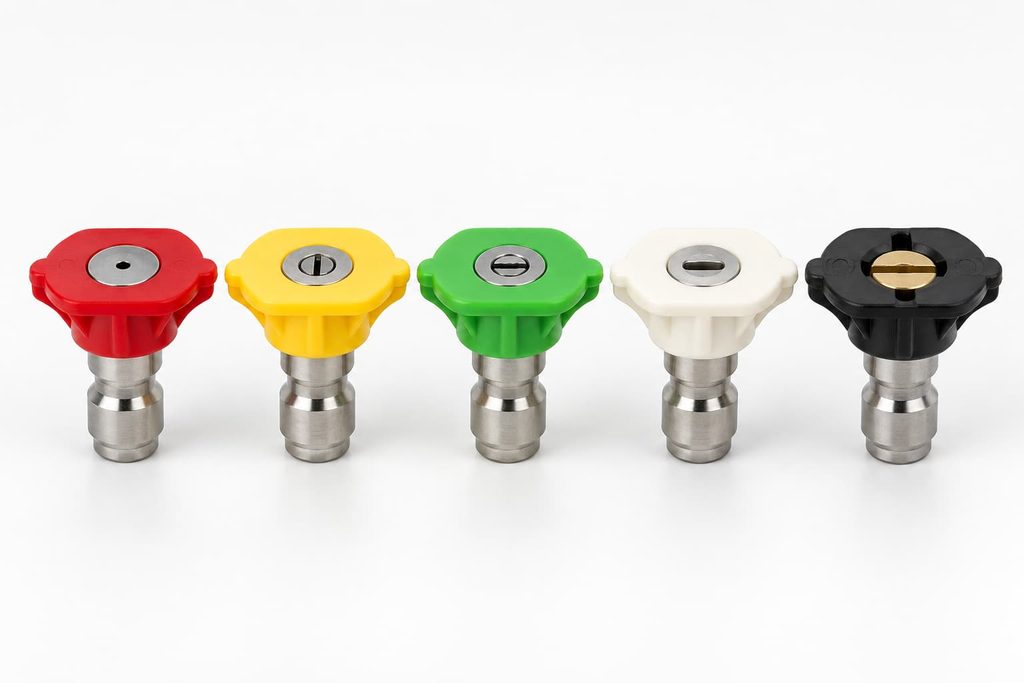
Pressure washer nozzles are colour-coded by spray angle: red (0-degree) delivers maximum concentrated force, yellow (15-degree) suits heavy cleaning, green (25-degree) handles general work and white (40-degree) provides gentle, wide coverage. Most pressure washers include all four plus a black soap nozzle for applying detergent.
| Nozzle | Colour | Spray Angle | Best For |
|---|---|---|---|
| 0-degree | Red | Pencil jet | Maximum force. Stubborn stains, small areas. Use with caution. |
| 15-degree | Yellow | Narrow fan | Heavy cleaning. Concrete, brick, stripping. |
| 25-degree | Green | Medium fan | General cleaning. Decks, fences, vehicles. |
| 40-degree | White | Wide fan | Light cleaning. Rinsing, delicate surfaces. |
| Soap nozzle | Black | Low pressure wide | Applying detergent before cleaning. |
A turbo nozzle (also called a rotary nozzle) combines the force of a 0-degree jet with a spinning circular motion. This delivers aggressive cleaning power across a wider area than a standard 0-degree tip, making it effective for concrete, brick and heavily soiled surfaces.
| 💡 Other pressure washer types. Battery-powered pressure washers are an emerging option for light portable cleaning, but current models deliver lower PSI than corded electric or petrol units. Hot water pressure washers are used in commercial and industrial settings for removing grease, oil and food residue where cold water alone is not effective. |
Pressure Washer Accessories Worth Adding
The most useful pressure washer accessories are a surface cleaner attachment, foam cannon, extension lance and turbo nozzle. These improve cleaning efficiency and extend the range of jobs your pressure washer can handle.
Pressure washers apply detergent through either a built-in detergent tank, a siphon tube that draws from an external container, or a separate foam cannon attachment. Built-in tanks are convenient for small jobs. Siphon tubes allow larger detergent volumes. Foam cannons produce thick clinging foam ideal for car detailing and pre-wash soaking.
| Accessory | What It Does | Best For |
|---|---|---|
| Surface cleaner | Rotating disc with two jets for even flat surface cleaning | Driveways, patios, large concrete areas |
| Foam cannon/snow foam lance | Sprays thick detergent foam for pre-wash | Car detailing, mould removal, pre-cleaning |
| Extension lance | Extends reach by 1 to 2 metres | Gutters, second-storey walls, high fences |
| Turbo nozzle | Rotating 0-degree jet for aggressive cleaning | Concrete, brick, stubborn stains |
| Drain cleaning kit | Flexible hose for unblocking pipes and drains | Blocked drains, downpipes |
Browse high pressure accessories at GPT Tools for attachments compatible with electric and petrol models
Maintenance: Electric vs Petrol
The most important pressure washer maintenance tasks are flushing the pump after each use, inspecting the high-pressure hose for damage and storing the unit in a dry location. Petrol models also require engine servicing, including oil changes, air filter cleaning and spark plug replacement.
| Task | Electric | Petrol |
|---|---|---|
| Flush pump after use | After each use | After each use |
| Inspect high-pressure hose | Before each use | Before each use |
| Check nozzles for blockage | Regularly | Regularly |
| Change engine oil | N/A | Every 50 hours or per manual |
| Clean air filter | N/A | Every 25 hours |
| Replace spark plug | N/A | Every season or 100 hours |
| Winterise pump | Drain water before storage | Drain water and fuel before storage |
| Store location | Dry, frost-free area | Dry, ventilated area |
Replacement pumps and parts are available in the pressure washer pumps range at GPT Tools.
Which Pressure Washer Should You Buy?
| Choose an electric pressure washer if you mostly clean cars, decks, patios, outdoor furniture and house exteriors near a power point. Choose a petrol pressure washer if you regularly clean concrete driveways, commercial surfaces or work on properties without mains power. If you need both light home cleaning and occasional heavy-duty work, a mid-range electric model with 2000+ PSI handles a wide range of jobs without the fuel, noise and maintenance of a petrol unit. |
Before buying, check the PSI rating, flow rate, pump type and included nozzles. Match the pressure washer to the surfaces you clean most often and confirm it fits your water source (mains tap or self-priming from a tank).
Buy Your Pressure Washer at GPT Tools
GPT Tools has been supplying tools and equipment to Australian customers since 2002. Visit the Campbellfield store to inspect electric and petrol pressure washers in person before buying, or shop online with Australia-wide delivery.
Frequently Asked Questions
For car washing, 1200 to 1500 PSI is sufficient. For decks and patios, 1000 to 1800 PSI. For concrete driveways and heavy cleaning, 2500 to 4000+ PSI. Match the PSI to the surface to avoid damage.
Yes, if the pressure washer has a self-priming pump. Most petrol models can draw water from a tank, bucket or dam without mains water pressure. Most electric models require a pressurised tap connection.
Electric models with 2000+ PSI can handle lightly soiled concrete driveways. For heavily stained or large concrete areas, a petrol model with 3000+ PSI and a higher flow rate will be significantly faster and more effective.
For most homeowners, an electric pressure washer provides enough power for typical cleaning jobs at lower cost, less noise and less maintenance. A petrol model is worth the investment if you clean large concrete areas, have no mains power access or need the machine for commercial or farm work.
They are the same product. Pressure washer, pressure cleaner, high-pressure washer and high-pressure cleaner are interchangeable terms used in Australia. Water blaster is the common term in New Zealand.
A foam cannon is not essential but significantly improves car washing and pre-wash cleaning. It sprays thick detergent foam that clings to surfaces and lifts dirt before contact washing, reducing the risk of scratching paintwork. Most foam cannons attach to the pressure washer lance via a quick-connect fitting.
Popular Pressure Washers at GPT Tools
-
15HP Petrol Engine – 25mm Shaft | Electric Start | 4-Stroke Motor for Go Karts & Log Splitters
Original price was: $790.00.$650.00Current price is: $650.00. Inc. GST -
15M Heavy Duty High Pressure Washer 5000 PSI HIGH PRESSURE HOSE
Original price was: $300.00.$200.00Current price is: $200.00. Inc. GST -
15M Heavy Duty High Pressure Washer 5000 PSI HIGH PRESSURE HOSE
Original price was: $300.00.$200.00Current price is: $200.00. Inc. GST

