

Box Trailer vs Cage Trailer: Which One Should You Buy?
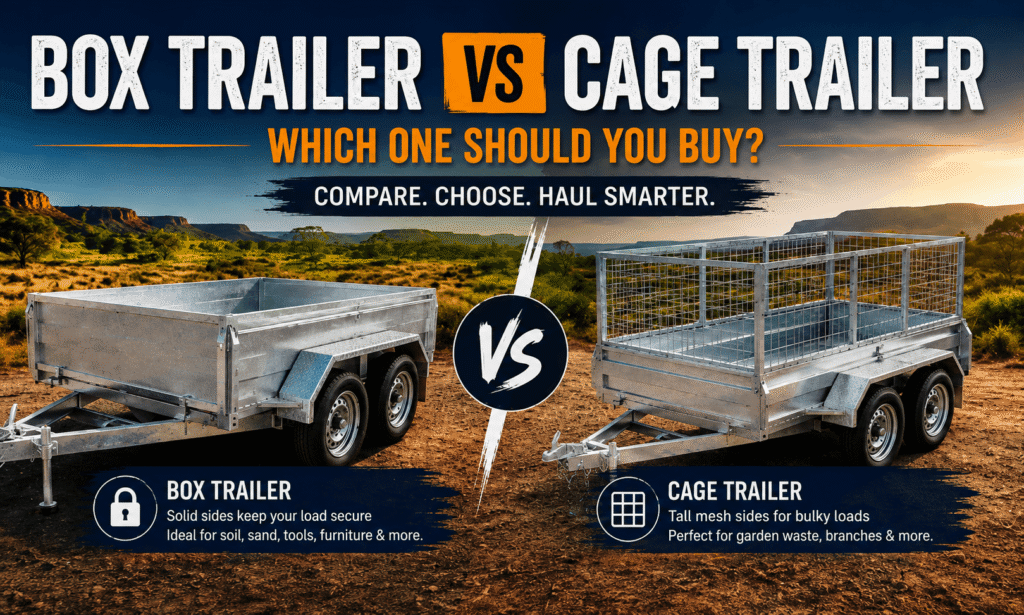
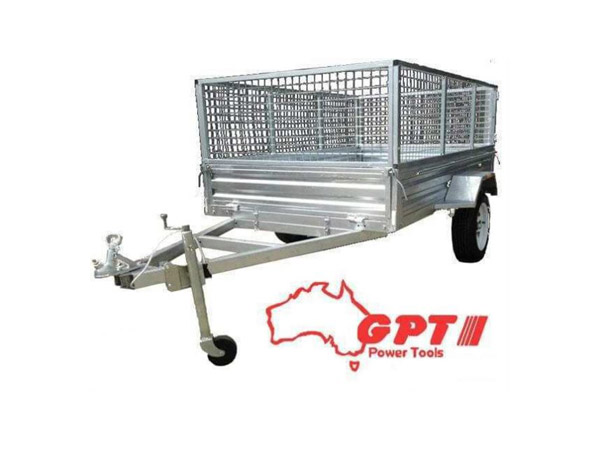
A box trailer has solid steel sides that keep small loose items contained, ideal for furniture, tools, soil, sand and general hauling. A cage trailer has tall mesh or bar sides that allow bulky, lightweight loads like garden waste, branches and green waste to be stacked well above the tray. If you need both, most box trailers accept a bolt-on cage kit so you can switch between configurations.
KEY TAKEAWAYS
- Box trailers have solid sides. Best for furniture, tools, soil, sand and items that need to stay contained.
- Cage trailers have tall mesh sides. Best for garden waste, branches, green waste and bulky lightweight loads.
- Most box trailers accept a bolt-on cage kit, so you can switch between both configurations without buying two trailers.
- Always check your vehicle’s towing capacity before purchasing. Unbraked trailers must not exceed 750 kg ATM in most states.
- Common Australian trailer sizes are 6×4, 7×5 and 8×5. Choose based on your typical load type and frequency of use.
- Galvanised steel construction resists rust and extends the trailer’s lifespan, especially for outdoor storage.
This guide covers the key differences between box trailers and cage trailers, the best uses for each type, how to choose the right size, towing capacity considerations and what accessories you may need. Browse the full trailer range at GPT Tools to see what is available.
What Is a Box Trailer?
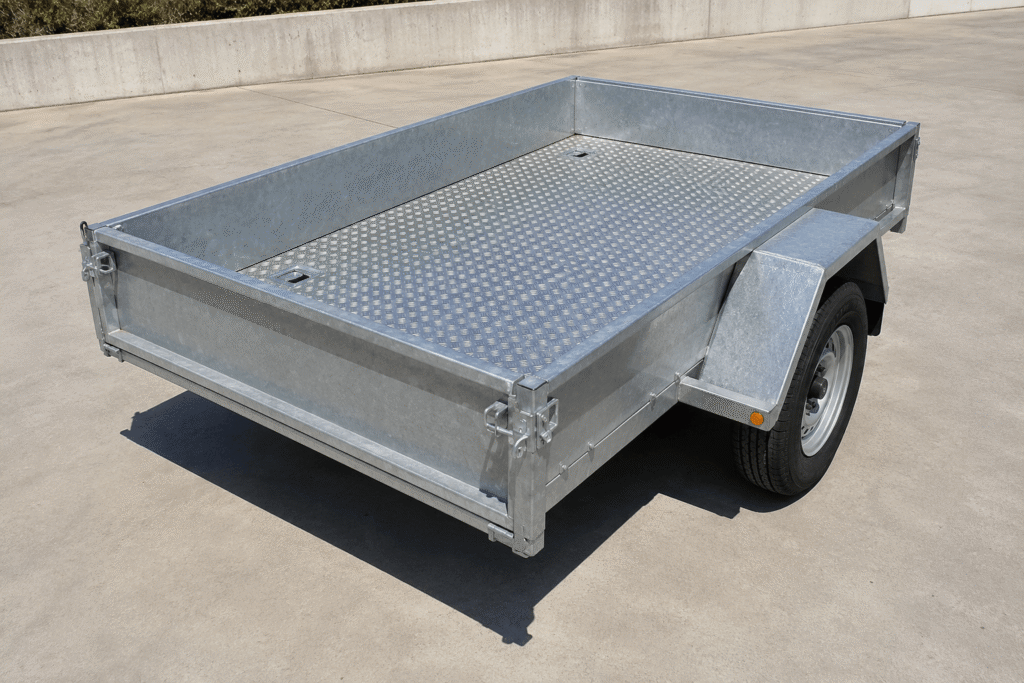
A box trailer is an open-top trailer with solid steel sides. The sides are typically 300 mm to 400 mm high and are welded or bolted to the trailer bed, creating a contained tray that keeps items secure during transport.
Box trailers are the most popular general-purpose trailer in Australia. They are commonly used for moving furniture, carrying tools and building materials, transporting equipment and handling everyday hauling tasks around the home or worksite.
Most box trailers feature a flat steel or checker plate floor with tie-down points for securing loads. Construction is usually mild steel or galvanised steel, with galvanised models offering stronger resistance to rust and corrosion over time.
Common box trailer sizes in Australia include 6×4, 7×4, 7×5, 8×4 and 8×5 (measured in feet). They are available in both single axle and tandem axle configurations depending on the required payload. See the box trailers available at GPT Tools.
What Is a Cage Trailer?
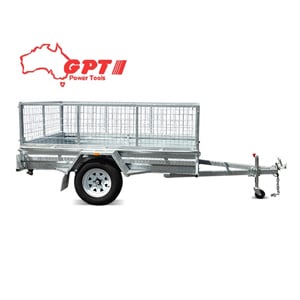
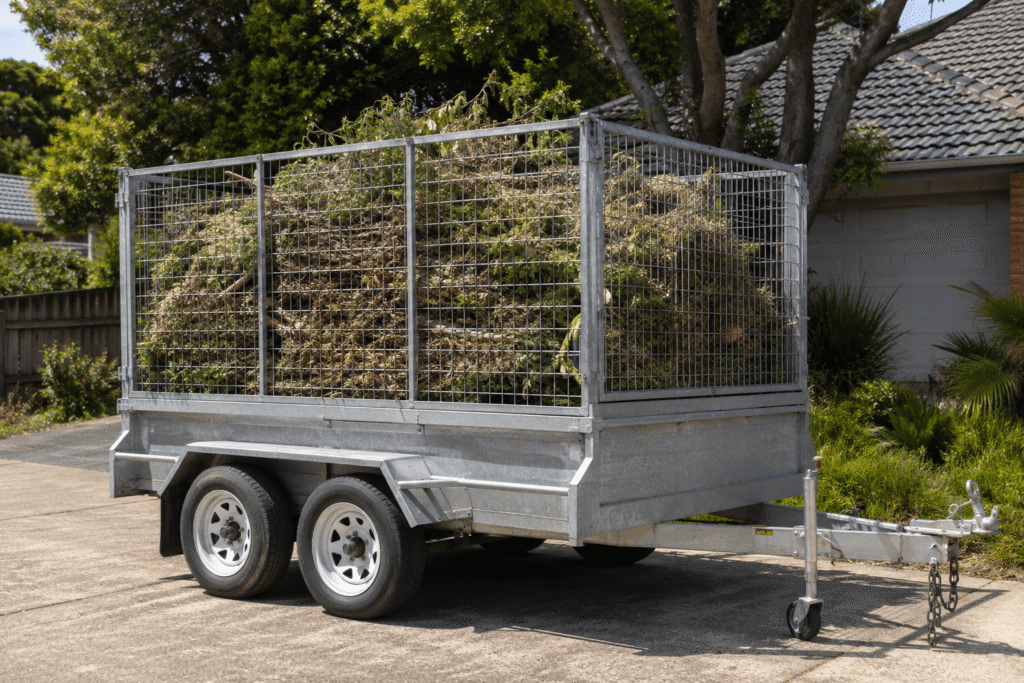
A cage trailer is a trailer with mesh or steel bar cage sides that extend above the tray, providing significantly more vertical load space than a standard box trailer. Cage heights typically range from 600 mm to 1200 mm.
The cage sides allow you to stack bulky, lightweight items well above the tray line. This makes cage trailers particularly effective for garden waste, green waste, branches, mulch, cardboard, plastic sheeting and other materials that take up a lot of space but do not weigh much per cubic metre.
The open mesh design also allows airflow through the load, which helps when transporting freshly cut green waste or other organic material that benefits from ventilation.
Like box trailers, cage trailers are available in common Australian sizes such as 6×4, 7×5 and 8×5. Many cage trailers use galvanised steel construction for durability and long-term weather resistance.
Box Trailer vs Cage Trailer at a Glance
| BOX TRAILER | CAGE TRAILER |
| ✓ Solid steel sides contain loose items | ✓ Mesh or bar cage extends load height |
| ✓ Best for furniture, tools, soil, sand | ✓ Best for garden waste, branches, green waste |
| ✓ Protects items from shifting in transit | ✓ Allows bulky oversized loads above tray |
| ✓ Side height: 300–400 mm | ✓ Cage height: 600–1200 mm |
| ✓ No airflow through sides | ✓ Airflow through mesh sides |
| ✓ Most versatile with add-on cage option | ✓ Ideal for landscaping and waste removal |
Key Differences Between Box Trailers and Cage Trailers
The main difference is the sides: a box trailer has solid enclosed walls that contain small loose items, while a cage trailer has tall open mesh sides that allow bulky oversized loads. This single design difference determines which trailer type suits each job.
| Feature | Box Trailer | Cage Trailer |
| Side type | Solid steel sides | Mesh or steel bar cage |
| Best for | Furniture, tools, soil, sand, equipment | Garden waste, branches, bulky items |
| Small item security | High. Items stay contained | Low. Items can fall through gaps |
| Load height | Limited to side wall (300–400 mm) | Extended by cage (600–1200 mm) |
| Airflow | None | Yes. Mesh allows ventilation |
| Add-on cage option | Available on most models | Already included |
| Versatility | Very high with removable cage | Primarily suited to bulky loads |
| Common sizes | 6×4, 7×5, 8×5 | 6×4, 7×5, 8×5 |
| Construction | Mild steel or galvanised | Mild steel or galvanised |
Which Trailer Suits Your Job?
A box trailer suits moving furniture, tools, soil and building materials. A cage trailer suits garden waste, branches and bulky lightweight loads. Here is how they compare across the most common Australian use cases.
Moving House or Furniture
Best choice: Box trailer. The solid sides protect furniture, boxes, appliances and personal items from shifting or falling out. You can strap items down using the tie-down points on the trailer bed and stack boxes securely against the walls.
A 7×5 or 8×5 box trailer provides enough floor space for a small to medium furniture load. For larger moves, consider a tandem axle model for additional payload capacity and towing stability.
Garden Waste and Green Waste
Best choice: Cage trailer. Branches, clippings, leaves, mulch and pruning waste are lightweight but take up a lot of space. The tall cage sides let you stack green waste well above the tray line, reducing the number of trips to the tip.
The mesh sides also allow airflow, which helps prevent moisture buildup when transporting freshly cut material. For regular garden maintenance or landscaping work, a cage trailer will save considerable time compared to making multiple runs with a box trailer.
Trade and Construction Use
Best choice: Box trailer for most tradies. Most tradespeople prefer a box trailer for transporting tools, toolboxes, small equipment, timber and building materials because the solid sides keep everything secure.
Builders and contractors removing demolition waste, offcuts, packaging or mixed site rubbish may prefer a cage trailer for the extra load volume. If your work involves both types of hauling, a box trailer with a removable trailer cage attachment gives you the flexibility to switch between configurations.
Farm and Property Use
Best choice: Box trailer with add-on cage. A box trailer with an add-on cage gives property owners the most flexibility. The solid tray handles fencing materials, firewood, gravel, soil, feed, posts, water tanks and general property maintenance tasks.
The bolt-on cage handles branches, scrub, hay and bulky green waste, where the extra height makes loading much easier. Many property owners invest in both a solid tray and a removable cage to cover all situations.
Can You Add a Cage to a Box Trailer?
💡 Tip: You don’t have to choose one forever.
Many box trailers are designed to accept bolt-on cage kits that attach to the top of the solid sides. This converts a standard box trailer into a cage trailer when you need the additional load height, and you can remove the cage when you want to use the flat tray.
This is one of the most practical solutions for buyers who cannot decide between a box and a cage trailer. Instead of purchasing two separate trailers, you buy a box trailer and add a removable cage as a separate accessory.
Before buying a cage kit, check that it is compatible with your trailer model and size. Cage attachments are commonly available for popular sizes like 6×4, 7×5 and 8×5 trailers.
Choosing the Right Trailer Size
The most popular Australian trailer sizes are 6×4 for light domestic use, 7×5 for trade and property work, and 8×5 for heavy commercial loads. The right size depends on your typical load weight and volume.
| Size | Best For | Typical Users |
| 6×4 | Light-duty hauling, small furniture, garden waste runs, domestic use | Homeowners, occasional users |
| 7×4 / 7×5 | Medium hauling, trade use, regular property work | Tradies, property owners |
| 8×5 | Heavier and bulkier loads, higher capacity | Landscapers, builders, commercial users |
When choosing a size, consider the gross vehicle mass (GVM) of the trailer and the payload it allows. The GVM includes the trailer’s own weight (tare weight) plus the maximum load. Subtracting the tare weight from the GVM gives you the actual payload you can carry.
Single axle trailers are lighter and easier to manoeuvre. Tandem axle trailers handle heavier loads with greater stability. Browse trailers by size: 6×4 trailers, 7×5 trailers and 8×5 trailers at GPT Tools.
Check Your Vehicle’s Towing Capacity
Your vehicle’s towing capacity determines the maximum trailer weight you can safely tow. In most Australian states, unbraked trailers must not exceed 750 kg ATM, while braked trailers can be much heavier depending on the vehicle’s rated limit.
Check your vehicle’s rated towing capacity in the owner’s manual or on the compliance plate before purchasing. Exceeding this limit is unsafe and may breach Australian road rules.
Braked towing capacity applies when the trailer has its own braking system. Most medium to large trailers sold in Australia include brakes.
Unbraked towing capacity applies to smaller trailers without independent brakes. In most Australian states, unbraked trailers must not exceed 750 kg ATM.
Matching your trailer to your vehicle is essential. A trailer that is too heavy for your vehicle will affect handling, braking distance and overall safety.
Trailer Registration in Australia
Trailers used on public roads in Australia must be registered with your state or territory road authority. In Victoria, trailer registration is managed through VicRoads.
All trailers sold for road use in Australia must comply with the Australian Design Rules (ADRs), which cover construction standards, lighting, couplings and safety requirements.
Registration requirements and costs vary by state. Check with your local road authority for current fees and processes. If you are purchasing a new trailer, the retailer can often advise on the registration process.
Essential Trailer Accessories
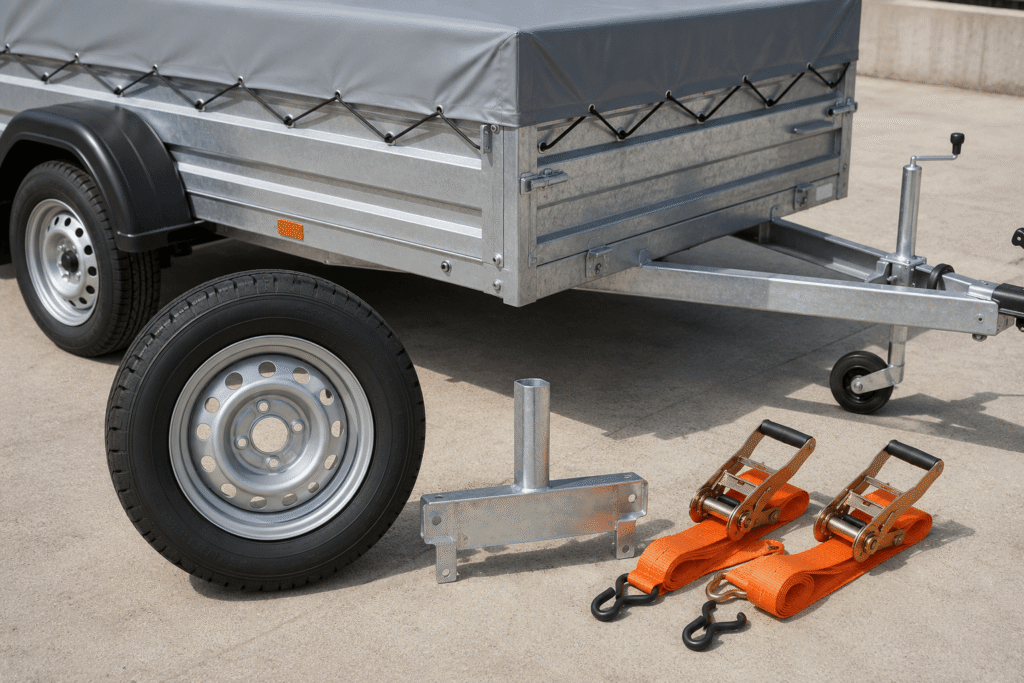
The most important trailer accessories are a trailer cover, spare wheel, tie-down straps, jockey wheel and coupling lock. These apply to both box and cage trailers.
| Accessory | What It Does |
| Trailer cover/tarp | Protects loads from rain, sun and wind |
| Spare wheel + bracket | Prevents being stranded roadside |
| Tie-down / ratchet straps | Secures loads to comply with road rules |
| Jockey wheel | Supports coupling when unhitched; easier parking |
| Trailer lock | Deters theft when parked or stored |
| Spare parts (bearings, lights) | Deters theft when parked or stored Keeps the trailer maintained and road-ready |
Which Trailer Should You Buy?
Choose a box trailer if you mostly carry furniture, tools, building materials, soil, sand or other items that need solid sides to stay contained. Choose a cage trailer if your main jobs involve garden waste, branches,green waste or other bulky lightweight materials that need extra height. If your work involves both types of hauling, buy a box trailer and add a removable cage kit for the best of both options.
Before buying, check your vehicle’s towing capacity, choose the right trailer size for your typical loads and make sure the trailer complies with Australian Design Rules for road registration.
Frequently Asked Questions
Box trailer prices in Australia vary by size, material and axle type. Smaller 6×4 models are the most affordable entry point, while galvanised or tandem axle 8×5 models cost more. Check the GPT Tools box trailer range at gpttools.com.au/box-trailers/ for current pricing.
Yes, for most buyers. Galvanised steel is hot-dip coated to resist rust and corrosion, significantly extending the trailer’s lifespan. This is especially valuable if the trailer is stored outdoors or used in wet conditions. Browse galvanised trailers at gpttools.com.au/galvanised-trailers/.
Many single axle trailers in Australia have a gross vehicle mass (GVM) of 750 kg, though heavier rated models are available. Check the trailer’s compliance plate for the exact GVM and subtract the tare weight to find the usable payload
Most passenger cars can tow a small to medium trailer. Check your vehicle’s braked and unbraked towing capacity in the owner’s manual or on the compliance plate before purchasing. In most Australian states, unbraked trailers must not exceed 750 kg ATM.
A cage trailer has open mesh sides and no roof, allowing tall loads and airflow. An enclosed trailer has solid walls and a roof for full weather protection and cargo security. Cage trailers suit bulky outdoor materials, while enclosed trailers are better for valuables and weather-sensitive goods.
A tandem axle trailer is worth considering if you regularly carry heavy loads or tow at highway speeds. Tandem axles distribute weight across four wheels, improving braking and stability. For lighter domestic use, a single axle trailer is usually sufficient.
Popular Cage Trailers at GPT Tools
-
NEW GPT CAGED 8X5 600M TRAILER COVER, GREEN/GREY WOVEN CANVAS
Original price was: $500.00.$400.00Current price is: $400.00. Inc. GST -
7×5 BOX TRAILER &TIPPER | 900MM CAGE | GALVANISED
Out of StockOriginal price was: $2,400.00.$1,800.00Current price is: $1,800.00. Inc. GST


Popular Box Trailers at GPT Tools
-
8X5 X900 HOTDIP GALVANISED FULLY WELDED TIPPER BOX TRAILER WITH( 900mm )REMOVEABLE CAGE
Out of StockOriginal price was: $2,700.00.$1,900.00Current price is: $1,900.00. Inc. GST -
Hot-Dip Galvanised 6x4x900 Fully Welded Tipper Box Trailer with 900mm Removable Cage
Original price was: $2,300.00.$1,600.00Current price is: $1,600.00. Inc. GST